The decision all but guarantees the building will be substantially completed before any final judgments and appeals are resolved.
Page A13From§Eachthe supper edition — 31 August 2026
Supreme Court lets White House ballroom construction proceed; its own conservative justice calls it unlawful.
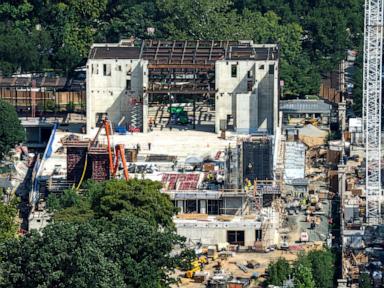
As it ran on the front
The Supreme Court did the responsible thing this week, and if that surprises you, you haven't been paying attention to how construction law actually works. The Court allowed White House ballroom construction to continue while — sure — a fight over statutory authority for the project is fully underway. That is not the Court overruling anybody. That is the Court declining to freeze a shovel mid-swing, which, ask any contractor, is how you avoid change orders. Five separate outlets ran with it the same week — CBS, ABC, the Washington Examiner, Fox, the New York Post — because it is, by any measure, a big and boring procedural story about scheduling.
Now. One of the nine justices — a conservative justice, appointed by a Republican president, no less — called the project 'unlawful' in the same ruling that let it keep going. I want to be careful here, because that sounds bad out of context. It sounds bad in context too, honestly. Did I say that? Strike that. What I mean is: dissents happen, that's the whole design of the institution, nine people, sometimes eight of them wrong. The point is the construction has a green light from the body that actually issues green lights, and one guy in a robe saying this shouldn't be happening while it happens is, legally speaking, just Tuesday.…
…(cont) The Washington Examiner's headline said the project got 'another lifeline' from SCOTUS, and I'd push back on 'lifeline' — projects that are lawful don't need lifelines, they need permits, which this apparently has, permits I have not personally seen, that a court says exist, allegedly. The New York Post ran the justice's 'unlawful' line right in their own headline too, which I'll admit is not the framing I'd have chosen if I were, hypothetically, choosing the framing.
Look. The ballroom gets built. Six different newsrooms confirmed the Court said yes. What they also confirmed, every single one of them, independently, without coordinating, is that the man writing the concurrence thinks the thing they said yes to breaks the law. I'm not going to sit here and tell you that's normal. I was going to. I'm not.
What matters here is simple: the ruling and the objection to the ruling arrived in the same document, from the same bench, on the same day. That's not a scandal, technically. It's just the kind of thing that used to be one.
“They fast-tracked a ballroom addition while abortion pill review sits on a 'we'll get to it' timeline, and that tells you what this Court considers urgent. A conservative justice on their own bench called the thing unlawful and the building keeps going up anyway. When even their own guy says stop and the answer is keep swinging the hammer, that's not a legal question anymore, that's who the building's for.”
“The Court didn't overrule anyone, it just declined to freeze construction mid-litigation, which is standard practice. One justice calling it unlawful is a dissent, not the holding — did I say dissent, it was a concurrence, either way. The ballroom has a green light from the body that issues green lights.”
The receipts
The Supreme Court divided 5-4 in allowing construction of the new White House ballroom to continue.
Chief Justice John Roberts warned the White House ballroom project is "likely unlawful," but the Supreme Court let construction continue for now.
The Supreme Court ruled 5-4 on Monday that construction can continue on President Trump's White House ballroom. CBS News' Jake Rosen reports.
The Supreme Court handed President Donald Trump a significant victory on Monday by allowing construction of the White House ballroom project to continue, rebuffing two lower federal courts that had ruled against the president. The high…
The court, in a 5-4 decision, rejected a challenge from National Trust for Historic Preservation that was seeking to halt the massive project slated to cost at least $400 million.
This page is a back-issue: the story as it ran, receipts as they were. The current edition is at the front.