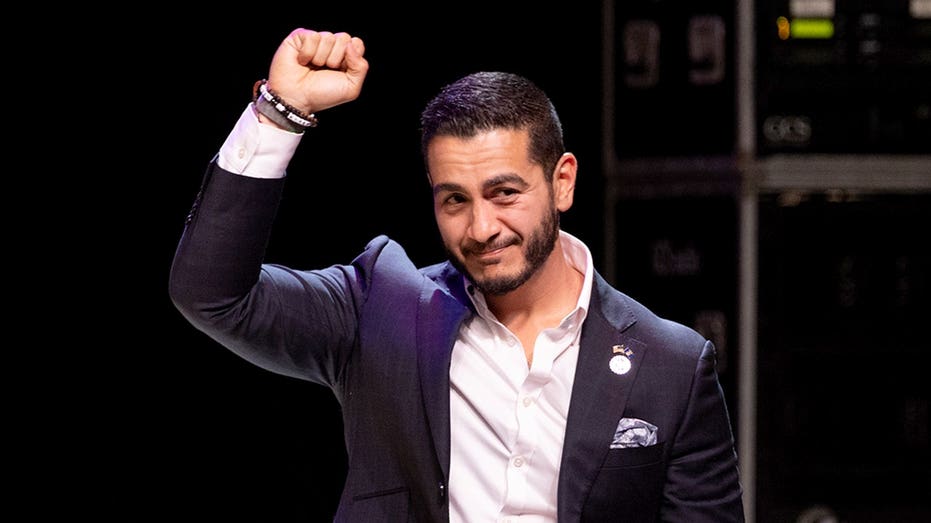
Democratic Michigan U.S. Senate candidate Abdul El-Sayed appeared to defend his criticism of Fourth of July fireworks on "The Breakfast Club" radio show.
Page A12From§Eachthe early evening edition — 31 August 2026
JD Vance Calls Michigan Senate Rival 'Evil'; NYT Frets Over His Podcast Ally; He Leads Poll
As it ran on the front
Let's do the euphemism autopsy first, because that's always where the body is. JD Vance stands in front of a crowd and calls a sitting candidate for the United States Senate 'evil.' Not 'wrong on the issues.' Not 'a socialist,' which is the usual costume word. Evil — the word you reach for when you've run out of policy and need something with teeth. That's not rhetoric slipping, that's rhetoric giving up.
Meanwhile, the New York Times, august institution, runs a piece asking how that same candidate could 'dispatch his Hasan Piker problem' — like the man's got a plumbing issue instead of a podcast friend. Notice the framing: not 'should he,' not 'is it fair,' just 'how' — the verb already assumes the guy's guilty of something, and the something is never named because there's nothing to name. That's the paper doing opposition research and calling it analysis.…
…(cont) And in the middle of all that noise, El-Sayed gets asked about fireworks — actual Fourth of July fireworks — and instead of the usual flag-hug photo op, he tells people to find other ways to show they love the country. That's it. That's the whole scandal. A guy suggests you don't need to set off explosives to prove patriotism, and somehow that becomes a storyline running parallel to 'evil' and 'problem' in the same news cycle.
Here's the part that should bother you more than any of the individual pieces: none of it worked. He's still ahead in the poll. Not by some landslide miracle, just ahead — the actual, measurable number the panic was supposed to move, and it didn't move. When the vice president's strongest word and the paper of record's most pointed framing both land on the same guy in the same month and the guy's polling is unchanged, that's not a coincidence, that's a receipt. It tells you the 'evil' framing and the 'problem' framing were never really aimed at persuading voters — they were aimed at the donors, the cable panels, the next fundraising email. The actual electorate wasn't in the room when they wrote those lines, and it shows, because the electorate went and did something else entirely.
Keep an eye on this one. Not because El-Sayed's going to win or lose — that's not the point I'm making — but because 'evil' is a word you only get to use so many times before people stop flinching at it. And once they stop flinching, you've spent the word for nothing, on the record, in a speech, forever.
“Vance stands up in a speech and calls the guy 'evil,' the Times spends a whole news cycle worrying about his podcast friend, and meanwhile the actual voters go ahead and put him ahead in the poll anyway. That's the tell — the panic is happening in green rooms and op-ed pages, not in the electorate. When the smear and the coverage of the smear both fail to move the number, the number's the only receipt that matters.”
“Calling a candidate 'evil' isn't rhetoric, it's — well, actually it kind of is rhetoric, that's what speeches are, did I say evil, I meant deeply, deeply misguided on the issues. And frankly if the Times wants to write about his podcast associations that's their editorial call, not ours, we just noted it in a speech, that's all, moving on.”
The receipts
Vice President JD Vance also told Dr. Abdul El-Sayed, Michigan’s Democratic Senate nominee, to “keep my wife’s name out of your mouth.”
Michigan Democratic Senate candidate Abdul El-Sayed is leading opponent former Rep. Mike Rogers (R-Mich.) by a few points in the battle for a seat in the upper chamber, according to new polling. In the EPIC-MRA poll, 43 percent of…
Republicans hold their trolls close. For Democrats, it’s more complicated.
This page is a back-issue: the story as it ran, receipts as they were. The current edition is at the front.