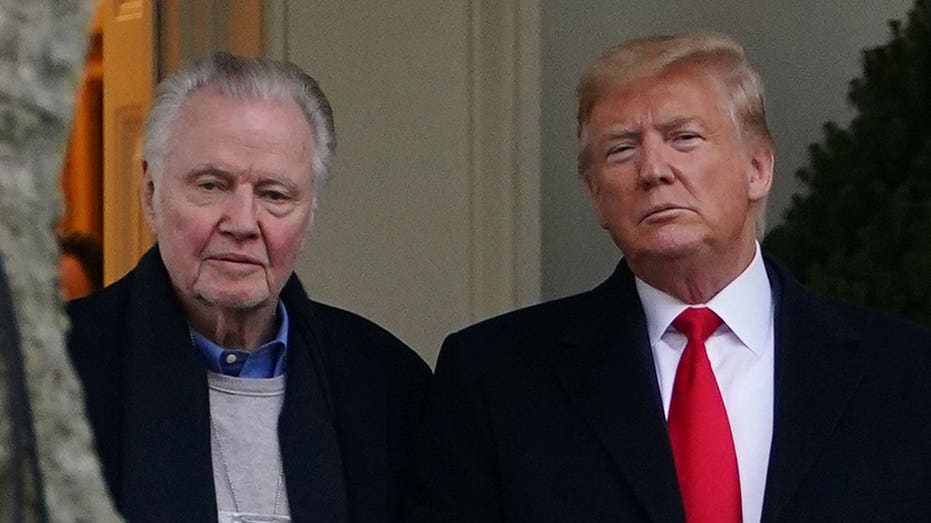
Jon Voight previously met with Trump at Mar-a-Lago to push a federal tax incentive aimed at reviving domestic film production and saving Hollywood jobs.
Page F3From§Eachthe milkman edition — 1 September 2026
Trump calls Hollywood a 'disaster' after meeting Jon Voight, then demands federal tax breaks to fix it.
As it ran on the front
Let's run the filing. On one line: the President of the United States, following a private meeting with actor Jon Voight, describes the domestic film industry as a 'total disaster.' On the next line, across three separate wire reports within days of each other, the same President demands Congress pass a federal tax incentive to rescue that same industry. Between those two lines sits the entire transaction, and it reconciles cleanly, hon.
The industry in question is not short on capital. What it has lost, according to the outlets covering these remarks, is production share to incentives offered by other countries and, increasingly, other states. The proposed fix, repeated across Fox News, the Washington Examiner, and the New York Post, is a federal tax incentive — meaning the credit does not come from a studio's marketing budget, it comes from the general fund, the same fund that also, this week, covers the CDC's measles review and the deportation flights covered elsewhere on this page.…
…(cont) What's notable is the sequence, not the ask. A tax credit for film production is not, on its own, unusual policy; states have run them for two decades with mixed results, largely subsidizing production companies that would have filmed somewhere regardless. What's unusual is the compression: meeting, insult, demand, all inside what the record shows as a single news cycle. The gap between 'total disaster' and 'please subsidize this industry I just called a disaster' is not a policy gap. It's a paragraph break.
Nobody in the record disputes that film production has economic value, or that other jurisdictions compete for it with public money. The question the filing doesn't answer is why this particular ask, at this particular size, arrived this particular week, attached to this particular meeting. The receipts don't name a dollar figure yet — that comes later, in the bill text, where the real reconciliation happens. Until then, what's on the page is a complaint and a request for public funds, filed back to back, with a movie star as the notary. The number's coming. It always does. Keep the filing open.
“Every time a guy like this shows up in his living room, the taxpayers get a bill somewhere down the back nine of the news cycle, and this one's a rerun — call it a disaster, call in the actor, sign the incentive. That's not tax policy, that's a favor with a filing number.”
“Look, the American film industry is hemorrhaging jobs to Canada and Georgia, this isn't a Voight favor, it's economic strategy — did I say Voight? I mean it's about jobs, purely about jobs, the meeting was incidental, nothing to see there.”
The receipts
President Donald Trump on Monday pressed Congress to pass federal tax breaks to revive the U.S.’s film industry, after speaking with his “special ambassador” to Hollywood, actor Jon Voight. Trump revealed he had a “great” meeting with the…
President Trump called on Congress to quickly approve a nationwide tax incentive for film and television production, throwing his weight behind a rare bipartisan push to lure entertainment jobs back to the US.
This page is a back-issue: the story as it ran, receipts as they were. The current edition is at the front.