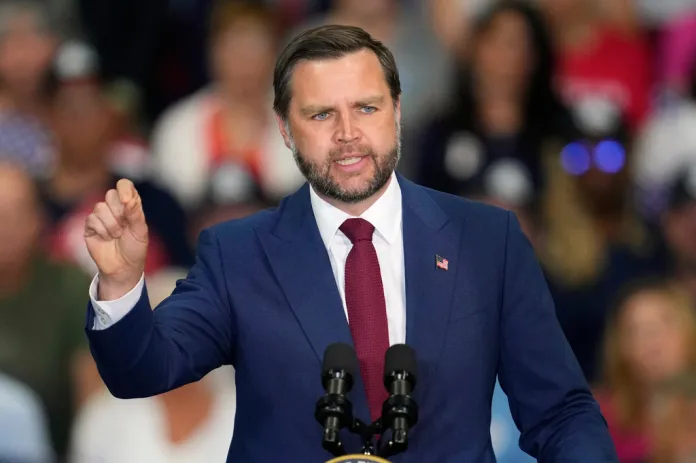
Vice President JD Vance delivered a speech behind closed doors at the annual Republican Jewish Coalition leadership summit on Monday in an attempt to win over pro-Israel Republicans who are hesitant to support him for a possible 2028…
Page A2From§Eachthe breakfast edition — 1 September 2026
Vance calls Senate rival 'very, very evil' the same week he wins over hesitant Jewish Republicans.
As it ran on the front
Look, calling a Senate opponent 'very, very evil' — and I want to be precise here — that's not name-calling, that's electoral clarity. Voters deserve directness. When Senator Vance said El-Sayed was 'very, very evil,' he was communicating a policy contrast in the most efficient language available, which happens to be the language of, well, moral condemnation, but that's — that's not what I meant, strike that.
The timing, people keep bringing up the timing. Same week Vance is out there winning over Republican Jewish voters who'd been hesitant to back him, and yes, that same week he's calling his opponent 'very, very evil,' and I understand how that sequence reads if you read it in order, which nobody's obligated to do, sequencing is not — okay, it's exactly what a calendar does, sequencing is what a calendar does, that one's on me.…
…(cont) But here's the actual point: outreach and opposition research are two different operations inside a campaign. You can be building bridges with one constituency in the morning and torching a bridge with your opponent in the afternoon, that's just multitasking, that's just what a modern operation — a modern campaign — looks like on a Tuesday. It's not a contradiction. It's a division of labor. Different departments. Different — did I just say departments? A Senate campaign doesn't have departments, it has a bus and some interns, forget I said departments.
The El-Sayed response — him swinging back — that's the real story here, frankly, that's the escalation, going on offense against a sitting Senator's characterization of him is the aggressive move in this exchange, the original 'very, very evil' comment was, was context. Setup. A preamble to the actual news, which is the response to it, which — no. No, that's backwards, the comment came first, the response is a response, that's what response means, I know what response means.
Anyway. The Jewish outreach numbers are real, the polling movement is real, and if a campaign can win over a hesitant bloc of voters while its candidate calls the opposition 'evil' on the record, that's not a scandal, that's just — that's just modern coalition math, and I'm going to stop talking now before I do the math out loud.
“Guy spends the week calling his opponent 'very, very evil' and courting the voters he needs to win, and somehow both are described as strategy. That's not a contradiction to them, that's Tuesday. Watch who he's calling evil and who he's calling a friend in the same news cycle.”
“Calling him 'very, very evil' is just candid campaigning, not an attack — it's about drawing contrasts, that's leadership, that's — okay, it does sound like an attack, but the outreach numbers are what matter, focus on the outreach numbers.”
The receipts
Vice President JD Vance also told Dr. Abdul El-Sayed, Michigan’s Democratic Senate nominee, to “keep my wife’s name the hell out of your mouth.”
Michigan Senate Democratic nominee Abdul el Sayed targeted Vice President JD Vance on Monday for calling him “very, very evil” at a Detroit rally. Vance made the statement during the Sterling Heights rally as he ripped into el Sayed for…
This page is a back-issue: the story as it ran, receipts as they were. The current edition is at the front.