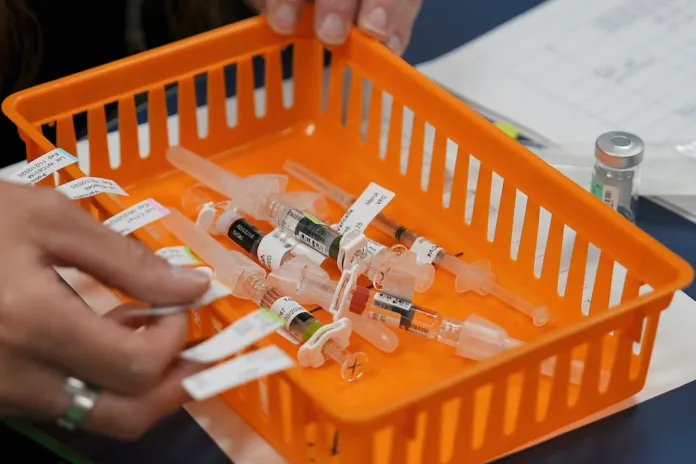
The mother of a 5-year-old is urging the Supreme Court to allow her son to enroll in kindergarten while she continues fighting a legal battle for a religious exemption to New York’s mandatory vaccination requirements for students. The…
Page A6From§Eachthe breakfast edition — 1 September 2026
Supreme Court seals its own history while deciding whether a kindergartner can stay in school unvaccinated.
As it ran on the front
Follow along at home, folks, records in hand — or rather, not in hand, because that's rather the whole caper. Exhibit one: the Supreme Court, an institution that issues its opinions to the entire country in real time, maintains its own historical archive under rules so restrictive that reporters describe the effort to see it as 'locked away.' Not sealed for national security. Not sealed for grand jury secrecy. Locked away because it is, apparently, the Court's paper, and the Court would like to keep it that way.
All together now — line one: an institution that decides what every American must live under keeps its own working papers off-limits to those same Americans. I'm not accusing anyone of anything. I'm reading the label on the box, and the label says 'Access Restricted,' and I am, as instructed, respecting that.…
…(cont) Exhibit two, filed the same week, a rather smaller docket: a mother, a kindergartner, and a religious objection to a vaccination requirement, all now awaiting a ruling from the very same institution whose own paperwork we just discussed. The child's school status — in, out, pending — depends on a body that will explain its reasoning to the public eventually, on its own schedule, in its own time, the same schedule and time it uses for everything else it decides not to explain right away.
All together now, line two: the Court that will decide whether a five-year-old can stay in her classroom is not required to tell any of us, promptly or fully, how it decided anything else it has ever done. That's not a criticism. That's the org chart. I checked.
I want to be fair here — archives take time, process takes time, five-year-olds also take time, they're growing the whole time you wait. The paperwork will surface eventually, on the Court's terms, the way it always does. Whether the kindergartner is still in kindergarten when it does is, strictly speaking, a separate docket. I just work here, folks, turning pages, and this one, I'll be honest, doesn't turn easy.
“The same Court that won't let you see its own paperwork is about to decide whether a five-year-old stays in kindergarten, and it doesn't owe either of you an explanation on a timeline you get to know in advance. That's not an independent judiciary, that's a locked filing cabinet with a robe on. Ask them why the timeline's a secret and see how far you get.”
“The Court's archival practices are a matter of institutional continuity and orderly process, not secrecy — every branch manages its own records. As for the vaccination case, the Court doesn't rush constitutional questions for anyone's calendar, and it shouldn't, did I say for anyone, I mean for any one case, they're all equally unrushed.”
The receipts
After Justice Scalia died, the justices held private negotiations about locking away their papers. We may not see the ultimate record of the Roberts court for decades.
This page is a back-issue: the story as it ran, receipts as they were. The current edition is at the front.