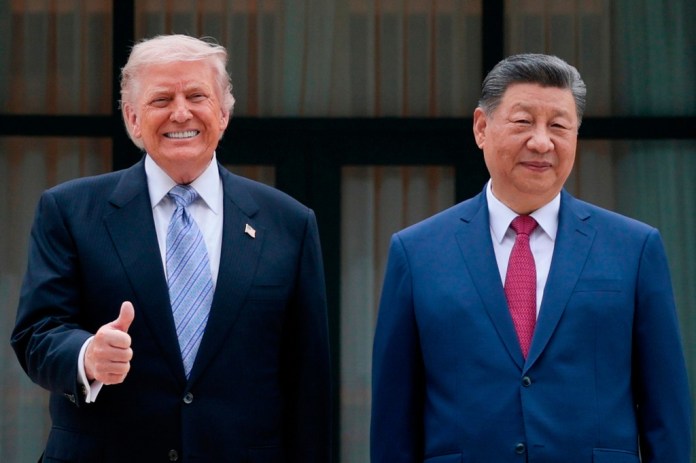
While headlines are dominated by election news and the war in Iran, our government is quietly getting ready for one of the most important events of the year. In under four weeks, President Donald Trump will host Chinese President Xi Jinping at the White House. The meeting comes at a crucial juncture for bilateral relations.
Page A3From§Eachthe noon edition — 2 September 2026
Canada tells Trump to stop being tough; unnamed bureaucrats then take blame for his failed China deal.
As it ran on the front
I wrote this down someplace... hold on... here — I keep a notebook now, since the glovebox got too full of receipts to close right. Two lines, both from this week. Line one: the Prime Minister of Canada, on the record, telling Mr. Trump to 'stop trying to be tough' in the trade fight. Line two: a Washington outlet reporting that 'deep state bureaucrats' are sabotaging what it calls his 'last chance' at a China megadeal. Same week. Both about why a trade deal isn't landing.
Now, I don't know much. I fix cars in my driveway because the shop charges ninety dollars just to look, and I know that when the belt keeps slipping, you can blame the belt, or you can blame the guy who installed it, or you can blame the weather — but at some point the car just tells you what's wrong, whether you go looking or not.…
…(cont) Here's what I keep circling back to in the notebook. Word one: tough. The whole trade fight, we're told, has been about being tough — tough with Canada, tough with China, tough is the entire selling point, right there in the coverage. And here's Canada's own head of government, on the record, saying: stop. Not 'we'll match your tariffs.' Not 'we're retaliating.' Just — stop trying to be tough. Like a neighbor telling you the fence you're so proud of building crooked isn't scaring anybody, it's just crooked.
Word two, same week: sabotage. Not 'the deal fell through.' Not 'talks stalled.' Sabotage — bureaucrats, unnamed, deep inside the machine, working against the very administration that appointed them, on the one deal we're told matters most. I sat with that a while in the garage, turning it over like a lug nut that won't seat right. If the tough approach is working — and toughness is the whole premise here, tough is the ask, tough is on the sign out front — then who exactly needs to sabotage it? You don't need a mole in the building if the plan's already failing on its own. Nobody sabotages a car that's already up on blocks.
I keep a toolbox out there too, mostly wrenches I inherited and never sorted right, and I got to thinking about which tool actually fits here. Is 'tough' the kind of word that describes what happened, or the kind of word you reach for right after it didn't? Because from where I'm standing — porch light on, dog asleep on the mat, nothing fancy — you don't usually hear both of those things about the same deal in the same week unless one of them's doing the work the other one can't.
So I wrote the question down plain, the way I write everything down: if the tough approach on trade was working, why did an ally publicly ask him to stop it — and if it wasn't working, is 'the deep state did it' a diagnosis, or is it just the receipt for a car that never started, filed under somebody else's name?
Oh — one more thing, before you go. That Canada quote and that 'sabotage' line both ran the same week, same trade fight, same word floating under both of them. So which is it: is 'tough' the word for the plan while it's still running, or is 'sabotage' the word somebody reaches for once it's already stalled?
“They sell you 'tough' the way a used-car lot sells you 'certified' — a word painted on for confidence, not a fact about the engine. The minute the China deal stalls, tough quietly turns into sabotage, and the sabotage always traces back to some unnamed bureaucrat nobody can subpoena. Canada just said the quiet part out loud, on the record, and that's the part that never makes the front page.”
“Look, 'tough' is a strategy, it's leverage, it's — it's not about winning every round, it's about the posture, and frankly Canada saying 'stop being tough' just proves the posture is working, they're rattled — wait, why would he stop something that's working if it's — no, the real story here is the deep state, unnamed career officials torpedoing the President's signature deal, that's — hang on, if nobody can name them, how do we know it's — never mind, next question.”
The receipts
Canadian Prime Minister Mark Carney told Americans to "stop trying to be tough" and called U.S. Cabinet secretaries' mockery "beneath their office."
This page is a back-issue: the story as it ran, receipts as they were. The current edition is at the front.