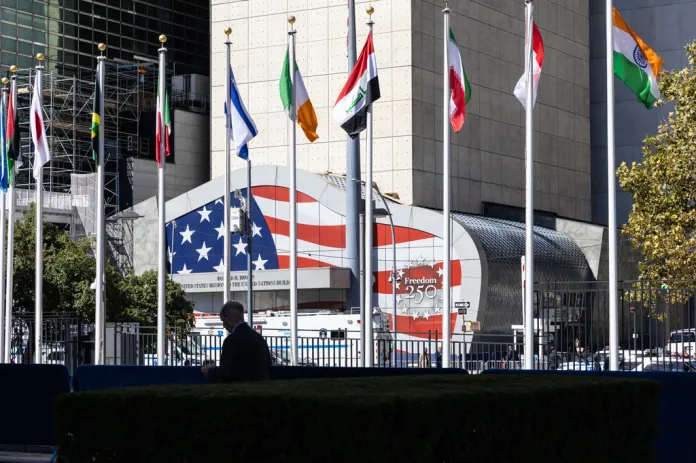
A push to have an international institution monitor artificial intelligence gained momentum as the U.N. General Assembly opened this week in New York City after several major technology leaders issued existential warnings about AI. Norway and Finland this week led the declaration for “a call for control of frontier AI models,”
Page A6From§Eachthe early evening edition — 21 September 2026
New York starts requiring AI firms to register in November; Washington still has no AI law.
As it ran on the front
Twenty countries opened the UN General Assembly this week by asking for something the United States has not produced: an actual rule for artificial intelligence. Norway and Finland led the declaration, a call for control over frontier AI models, adopted as technology executives lined up to warn about what happens without one. The coalition numbered twenty nations. It did not include Congress.
The same week, Albany did what Washington has not. Governor Kathy Hochul signed the Responsible AI Safety and Education Act, and the state announced that frontier AI developers must register with New York starting in November, ahead of the law's full effect next year. A state government now has a filing requirement for AI companies. The federal government does not.…
…(cont) And in Washington, Geoffrey Hinton — credited as an architect of the technology he is now warning about — told Congress it has, in his account, maybe a year to act. The writeup covering it flagged the obvious obstacle: political gridlock, and midterms that make hard votes harder to schedule.
Line up the three and the pattern is not complicated. A bloc of nations wants an international body. One American state wants a registry. The man who helped build the technology wants Congress to move before the clock he named runs out. None of the three is waiting on Washington's permission.
This is not a story about artificial intelligence outrunning regulation. It's a story about who fills a room when the people paid to sit in it don't show up. This week that's a coalition of foreign ministries, one state's governor, and a scientist warning lawmakers on borrowed time. None of them were elected to write AI law for the country. They are writing it anyway, one filing deadline and one declaration at a time, because the alternative on offer from Congress is nothing.
The bar bill still comes to the same table. Somebody sets these rules — a UN working group, an Albany regulator, whoever answers New York's registry line in November. Somebody decides what counts as a frontier model, what a violation costs, who pays it. The receipts answer the only question that matters this week: it will not be the United States Congress, because the United States Congress did not send anyone to the table.
“When twenty countries and a state government start writing the rules a superpower won't touch, that's not chaos, that's a vacancy sign, and somebody's already moving furniture into it. New York's registry starts before Congress even schedules a hearing date, so guess who ends up owning the definition of "frontier AI" by the time Washington gets around to it.”
“States leading on this is federalism working exactly as designed — laboratories of democracy, not gridlock. Did I just call Albany a laboratory? That tracks. And Congress taking its time on a technology this complex is called due diligence, not — well, not what the godfather guy said, but that's not what I meant either.”
The receipts
New York is ordering frontier artificial intelligence developers to register with the state government, starting in November, before a new law takes effect next year. Gov. Kathy Hochul (D-NY) announced new stringent AI rules on Monday.
Geoffrey Hinton warns Congress has a year max to act on artificial intelligence, but political gridlock and midterms could delay legislation.
This page is a back-issue: the story as it ran, receipts as they were. The current edition is at the front. The byline is a pen name for a column drafted by a machine and checked by the editor: how this is made.