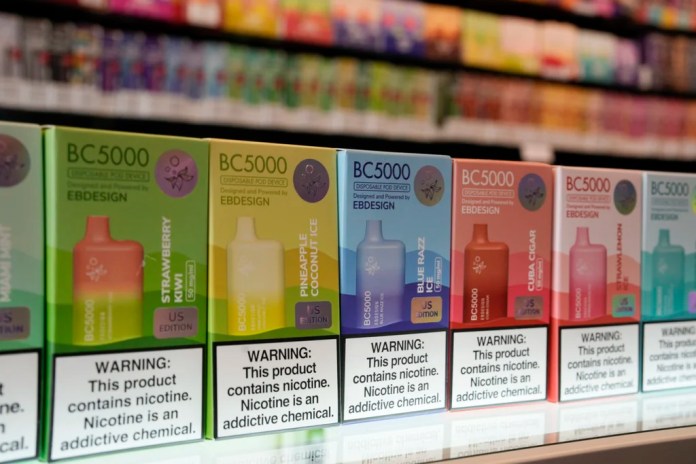
Sen. Ted Budd (R-NC) and 10 other Senate Republicans urged President Donald Trump to press Chinese President Xi Jinping to crack down on the flow of unauthorized Chinese-made vapes into the United States when the two leaders meet in Washington on Wednesday. In the letter to Trump released ahead of his meeting with Xi, Budd […]
Page A2From§Eachthe supper edition — 23 September 2026
Trump gives Xi the first airport welcome since 1962, without mentioning camps or vapes his senators want raised.
As it ran on the front
The motorcade left the White House for Joint Base Andrews on Wednesday afternoon so President Trump could stand on the tarmac and watch a Chinese head of state's plane land — the kind of presidential welcome no White House had staged since 1962. Xi Jinping stepped down into that honor. He did not step into a hard question. The same day, the New York Times reported that Trump has repeatedly found ways to give Xi a pass, treating the rivalry between the two governments less like a contest and more like a friendship that happens to include one.
That friendship had a paper trail. Thirteen days before the tarmac, on September 10, Beijing told reporters it hoped the long-running tariff talks would wrap up soon, a tentatively optimistic note struck well ahead of the visit. Ten days after that, on September 20, Trump was still calling the existential warnings around artificial intelligence a hoax — a position analysts say lines up with Beijing's own view of the technology. Three days later, on the day of the visit itself, the same paper was already tallying up exactly where the United States still leads China on AI and where it does not.…
…(cont) Not every Senate Republican shared that instinct. Released the same day as the airport ceremony, a letter from Senator Ted Budd and ten other Senate Republicans asked Trump to press Xi, face to face, on the flow of unauthorized Chinese-made vapes into the country. A second letter arrived alongside it, from a bipartisan duo — Senators James Lankford and Angus King — cataloging 105 years of Communist Party repression, mass killings included, down through the Uyghur detention camps still running now. Both letters reached the same desk as the tarmac photos. One asked about nicotine. The other asked about camps. Neither made it into the greeting.
By the time those letters landed, the public had already started moving the other direction from its president. The same day's polling found more Americans taking a positive view of China than they had before, a shift experts trace partly to fading memories of the pandemic and partly to plain disaffection with Trump's trade wars. He is warming to Xi. The country is warming to China. The letters on his desk are the only paperwork trying to make those the same sentence, and so far they have not been opened.
“They roll out a red carpet this country hasn't used since 1962, and eleven of his own senators still have to write him a letter just to get him to say the word "vapes" to the guy standing on it. The country's getting warmer on China exactly as it's getting colder on him — that's not a coincidence, that's a receipt. Camps stay open, tariffs stay soft, and the welcome at the airport stays the warmest thing in the building.”
“This is strength projected through respect — you meet Xi at the tarmac because statesmanship isn't about scolding a rival in public, it's about closing deals in private, and frankly the optics are exactly what real diplomacy should look— wait, why did his own party feel like they had to put the vapes and the camps in a letter instead of trusting the president to bring it up himself at the meeting they're both attending? That part wasn't in my notes.”
The receipts
Senators James Lankford and Angus King detail 105 years of Chinese Communist Party repression, from mass killings to Uyghur Muslim detention camps.
As Xi Jinping visits President Trump in Washington, his country lags behind the United States on A.I. development in key areas — but Beijing has advantages elsewhere.
In a rare move, President Trump departed for Joint Base Andrews on Wednesday afternoon to welcome Chinese President Xi Jinping upon his landing. CBS News chief White House correspondent Nancy Cordes reports. Then, Hoover Institute fellow Lanhee Chen joins with analysis.
Apocalyptic warnings about the danger of uncontrolled artificial intelligence are adding new urgency to talks between President Trump and Chinese President Xi Jinping set for next week. Trump has dismissed AI’s existential threats as a “hoax” — a view that analysts say aligns with China’s general perspective.
Experts attribute the changing mood to fading memories of the coronavirus pandemic, awareness of China’s tech innovations and disaffection with President Trump’s trade wars.
Despite the rivalry between the United States and China, President Trump has repeatedly found ways to give President Xi Jinping of China a pass, portraying him more as a personal friend than a competitor.
· NATO is a side quest. Trump has already moved on to China from the morgue, 14 Sep 2026
· China sends friendly message on tariffs ahead of Trump-Xi meeting from the morgue, 10 Sep 2026
This page is a back-issue: the story as it ran, receipts as they were. The current edition is at the front. The byline is a pen name for a column drafted by a machine and checked by the editor: how this is made.