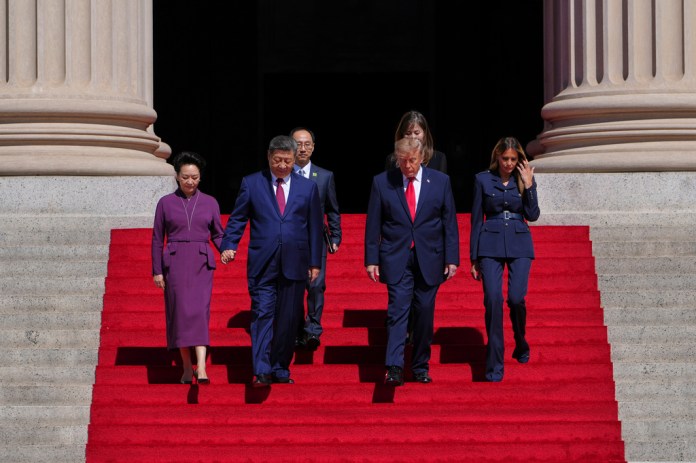
From the National Archives to the state dinner, President Trump and Xi Jinping looked comfortable together in Washington. Two former NPR China correspondents on what the visit did and didn't deliver.
Page F2From§Eachthe wee small hours edition — 27 September 2026
THE TARIFF LEDGER
Bessent floats a tariff cut on 'noncritical' goods; five days later, the summit delivers one worth $30 billion.
As it ran on the front
On September 21, Treasury Secretary Scott Bessent told CNBC that U.S. and Chinese officials were "considering" lowering tariffs on "noncritical" products, and that the two sides had floated a number: $30 billion. Five days later, in Washington, the number arrived exactly as floated — a finalized $30 billion tariff-cut agreement, folded into a summit that also produced a two-year coal deal and a new name for artificial intelligence. The filing matches the pitch to the dollar. That is not a coincidence to editorialize about; it is a timestamp to reconcile.
Run the ledger back further and the timestamps keep matching older ones. In September 2018, the opening move was a flat 10 percent tariff on $200 billion in Chinese goods, with 25 percent threatened by year's end if China retaliated. By May 2025, the number had climbed to 145 percent — an emergency rate, not a policy, the kind of number that exists to be walked back from — and a deal cut it to 30, with China's retaliatory rate falling from 125 to 10. That 2025 deal carried a 90-day clock. Ninety days from May 12 puts the expiration in early August 2025. It is now September 2026.…
…(cont) The pattern now runs four entries deep: 2018's 10 percent opener, 2025's spike to 145, 2025's climbdown to 30, and 2026's $30 billion cut. The first three share a column — they are rates, percentages, the same axis moving up and down. The fourth does not. Nobody in the receipts states what rate $30 billion in goods now carries; the filing gives a dollar figure on one line and a percentage history on another, and the two never share a row. That is the gap, hon: not the size of the cut, but the fact that the unit keeps changing every time someone asks what it costs.
Somebody still signs the form. The rebrand ran on a separate track. The two leaders agreed to call artificial intelligence "super intelligence." The chatbot did not get smarter over the weekend. It got a new name, filed the same week as a tariff figure with no rate attached to it, both items landing on the same table, reconciled here because the ledger, unlike the announcement, has to add up.
“They've been running this play since 2018 — jack the number up, knock it back down, call the drop a deal, and everybody claps like the tax wasn't the whole point. Nobody's saying what percentage thirty billion dollars of goods actually carries now, and that's not an accident, that's the trick — you can't be mad about a number they never wrote down. Meanwhile the shelf price hits your kid's Christmas list right on schedule, every single time, whatever they end up calling the robot.”
“Look, a $30 billion tariff cut is a win, full stop — lower costs, more trade, that's the whole ballgame, and if Secretary Bessent happened to preview it five days early that's called diplomacy, not a script. The 90-day window on the 2025 deal — okay, technically that lapsed, but — did I say "technically"? These things get extended administratively all the time, nobody needed to announce that part. And "super intelligence" is just... better branding. Stronger word. Doesn't mean anything changed. Why would that matter.”
The receipts
The United States and China have cut several deals during President Donald Trump’s visit with Chinese President Xi Jinping in Washington, D.C., this week, including finalizing a $30 billion tariff agreement, a two-year coal deal, and advancing artificial intelligence talks. Trump and Xi have had a complicated relationship throughout…
President Donald Trump can deliver a timely economic win before the holiday shopping season by using the new U.S.-China Board of Trade to reduce tariffs on everyday consumer goods. Tariffs on imports from China have been defended as leverage against unfair trade practices and a tool to protect strategic industries. But not every product…
The stakes were high during the meeting between President Donald Trump and Chinese President Xi Jinping.
The White House said the two leaders agreed on using the term "super intelligence" rather than "artificial intelligence" to describe the technology.
The United States and China agreed to slash tariffs on $30 billion in goods after Trump and Xi Jinping's three-day Washington summit this week.
Treasury Secretary Scott Bessent said Monday officials from the U.S. and China are considering lowering tariffs on “noncritical” products, as President Trump prepares to host Chinese President Xi Jinping this week in Washington, D.C.
· The U.S. and China agree to a trade deal in which, for 90 days, U.S. tariffs on most Chinese goods will drop from 145% to 30%, while China's retaliatory tariffs on U.S. goods will drop from 125% to 10 from the morgue, 12 May 2025
· The United States announces a 10% tariff on $200 billion worth of Chinese goods to start on September 24, increasing to 25% by the end of the year, and threatens tariffs on an additional $267 billion from the morgue, 17 Sep 2018
· Trump is making Canada worth courting — and China has noticed from the morgue, 15 Sep 2026
This page is a back-issue: the story as it ran, receipts as they were. The current edition is at the front. The byline is a pen name for a column drafted by a machine and checked by the editor: how this is made.