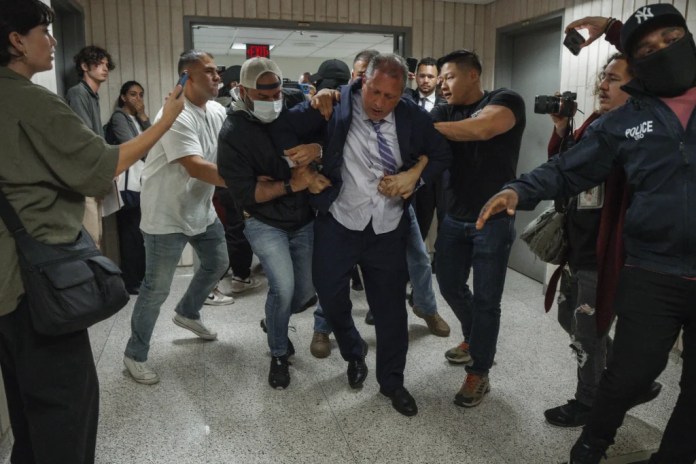
“Federal judge blocks ICE from arrests in New York courthouses”, 2 October 2026 (Photo via Washington Examiner — the original report)
As it ran on the front
The chief's job this month is inventory, not invention: before the crew builds anything new, check what's still bolted to the floor from the last administration, or the one before that. On September 1st the federal government sued Virginia over Governor Abigail Spanberger's law limiting local police cooperation with ICE, arguing it interfered with federal authority over immigration enforcement — a federal judge agreed and blocked the state law, the planner noting the part doing the work was the oldest one in the drawer: federal supremacy over the states, no amendment required.
Three weeks later the tinkerer is back at the bench. In Texas, Wilber Rafael Garces Perez, a 28-year-old delivery driver shot by an ICE agent and moved between a hospital and a detention cell with the officer's bullet reportedly still in his back, got a federal judge to block his deportation and order him produced for a hearing. The tool was due process, the kind of check that showed up again when a government tried to remove someone from the country before a court finished asking what happened — nothing new fabricated, just dusted off and bolted on.…
…(cont) By October 2nd the crew has both halves of the kit on the table at once. In Manhattan, Judge P. Kevin Castel — a George W. Bush appointee — ruled the Trump administration's policy for arresting immigrants inside New York City's immigration courthouses was invalid and blocked it indefinitely, the muscle knocking out the policy's legal footing with the same federal due-process authority the Virginia and Texas cases leaned on.
What got built on October 2nd is not complicated: one blocked firing, one blocked arrest policy, two judges appointed by presidents of different parties, one existing statute apiece, zero new laws passed to make any of it possible. The planner checks the manifest and finds nothing invented — due process in Texas, in New York, civil-service protection in Washington state, federal supremacy in Virginia, four jobs done by parts already in the warehouse. The pilot doesn't need a faster plane. The runway was poured decades ago; the crew just checked it was still there before taking off.
🍺
“They didn't need a new rulebook to catch this president breaking the one on the shelf — that's the part they'd rather you miss. A civil-service law from before half these officials were born and a courthouse due-process rule did the job, because the job was never that complicated. The scary part isn't that the law worked this time; it's how close it came to not getting the chance.”
“These are activist judges legislating from the bench — an Obama appointee, and, well, actually a Bush appointee too, so maybe not — look, the point is the president has Article Two authority to manage his own appointees and nobody elected these judges to slow that down. Did I just argue a Bush judge is part of the deep state? That doesn't sound like me.”
A federal judge has indefinitely blocked ICE officers from arresting illegal immigrants at immigration courthouses in New York City on the basis that the Trump administration’s policy for it was invalid. U.S. District Judge P.
President Donald Trump's firing of court-appointed U.S. attorney Roger Rogoff was blocked by Judge Stanley Bastian, sparking a separation of powers clash.
This page is a back-issue: the story as it ran, receipts as they were. The current edition is at the front. The byline is a pen name for a column drafted by a machine and checked by the editor: how this is made.