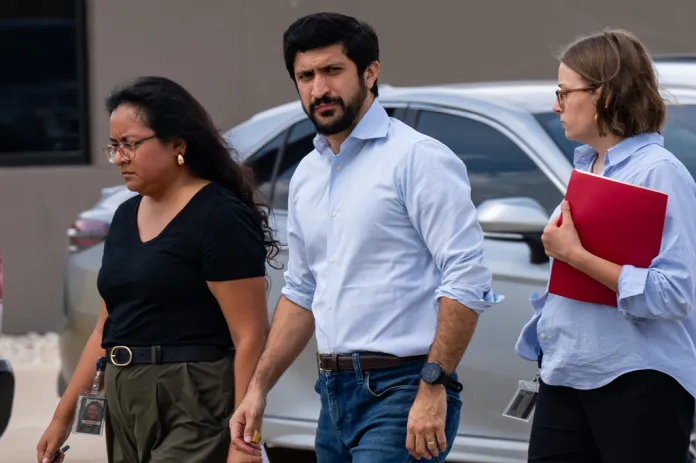
“Venezuelan man shot by ICE has bullet removed 11 days later”, 2 October 2026 (Photo via Washington Examiner — the original report)
As it ran on the front
He is shot on a Sunday, during a traffic stop in Austin, by an officer working Immigration and Customs Enforcement's removal operations. Wilber Rafael Garces Perez is twenty-eight. He drives for DoorDash. By Monday, according to his attorney, he is out of the hospital and in federal custody, and he is being interrogated — the bullet from that stop still in him, lodged near his spine. At a news conference that day, civil rights lawyers put him on the phone with reporters, because he is not free to stand in the room himself. He tells them, in his own words, that the bullet has not moved.
The charge is ready in eight days. The bullet is not.…
…(cont) A hospital does, in one procedure, what federal custody had not done through a week and a half of interrogation: treats the wound.
Lay the two processes side by side and the priority is visible. The charging document, naming the shot man as the aggressor, takes eight days to reach the public. The surgical extraction, on the same body, in the same custody the whole time, takes eleven. The faster paperwork answers for the officer. The slower paperwork helps the man the officer shot.
The first official output of his detention is not a surgical referral. It is an indictment.
This started as a traffic stop. A man pulled over, shot, interrogated with the bullet still in him, charged with assaulting the man who fired, and only then treated. The injury waited eleven days. The paperwork did not wait at all.
🍺
“They shoot the man, then charge the man for the shooting. The indictment against him clears in eight days; the bullet in his spine waits three more days after that — that's the government telling you which paperwork matters. When the agency that fired the gun also writes the charges, the shooting itself gets no outside review.”
“The charge is standard procedure — you resist a federal officer, you get charged, full stop, same as anybody would, including the guy who got shot. Did I say that? The surgery timeline is a medical decision, has nothing to do with who's drafting the indictment down the hall, that's just how hospitals schedule things.”
Wilber Rafael Garces Perez, the Venezuelan man who was shot by an Immigration and Customs Enforcement officer during a traffic stop in Austin, Texas, had a bullet removed from his back Thursday, nearly two weeks after the shooting. “Good news: Wilber Garces Perez finally had surgery to remove the bullet that was in his back […]
This page is a back-issue: the story as it ran, receipts as they were. The current edition is at the front. The byline is a pen name for a column drafted by a machine and checked by the editor: how this is made.