The U.S. ambassador said his office was "providing full cooperation with the investigation."
Page A5From§Eachthe milkman edition — 4 October 2026
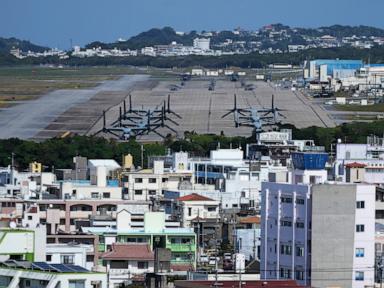
Marine murder arrest 'threatens to revive' Okinawa tensions last seen: 50,000 protesters, 2016.
As it ran on the front
A 20-year-old Marine named Jacob Ballad sat in an Okinawa jail this week on suspicion of robbing and murdering Anna Yagi, 39, at a hotel. The U.S. ambassador said his office was "providing full cooperation with the investigation," which is the exact temperature the United States keeps on hand for an Okinawa killing: warm enough to sound engaged, cool enough to commit to nothing. The New York Times reported the case "threatened to revive tensions over the American military presence on the Japanese archipelago," and "revive" is doing a lot of quiet work in that sentence, because tensions do not revive from nothing. They revive from somewhere they already were.
They were in Naha in June of 2016, when a Marine veteran working as a civilian contractor was arrested for the rape and killing of a 20-year-old woman, and more than 50,000 people filled the capital's streets in protest. That is not an abstraction; it is a specific count of specific people who left their jobs and their houses to stand in a street and ask for something to change about the arrangement that keeps the base running. The record, ten years later, does not show what they got for it. The record shows this.…
…(cont) Widen it past the island and the shape holds without the geography. In 2006 the Marine Corps charged seven Marines and a sailor with crimes including murder over the killing of a civilian in Al Hamdaniya, Iraq — not Okinawa that time, a different base, a different victim. The common thread across both years is not the location. It is the sequence: the charge is announced, the institution issues a statement about cooperation or review, and the arrangement that put the accused in that country in the first place is never itself named as a defendant.
So here is 2026: an arrest, a cooperating ambassador, a story that "threatens to revive" what evidently never finished dying.
“Fifty thousand people marched in Naha in 2016 and the base is still running under the same terms, which tells you exactly what that march was worth to the people who hold the lease on it. This isn't a pattern, it's a maintenance schedule: an arrest, a statement about cooperation, wait for the cameras to leave, repeat the arrangement. The ambassador's office didn't open an investigation into the agreement that put a 20-year-old on that island — it opened one into the suspect, and only one of those gets to survive this story.”
“Look, the alliance with Japan is the cornerstone of the entire Pacific security posture, and one isolated incident — tragic, nobody's disputing that — doesn't reflect on the thousands of service members stationed there honorably every day. Are we supposed to pull out of forward basing every time there's an — no, that's not — look, the ambassador said "full cooperation," that's the system working, that's accountability. It's not our fault the system keeps producing the same headline every ten years.”
The receipts
The matter threatened to revive tensions over the American military presence on the Japanese archipelago.
US Marine Jacob Ballad, 20, was arrested in Okinawa, Japan, on suspicion of robbing and murdering 39-year-old Anna Yagi at a local hotel, according to new reports.
· Over 50,000 people protest in Okinawa capital Naha against U.S. military presence on the Japanese island, spurred on by last month's arrest of an U.S. Marine veteran, civilian contractor for the rape from the morgue, 19 Jun 2016
· The United States Marine Corps announces that it will be charging seven Marines and one sailor with charges including murder in relation to the death of civilian Hashim Ibrahim Awad in Al Hamdaniya, I from the morgue, 21 Jun 2006
This page is a back-issue: the story as it ran, receipts as they were. The current edition is at the front. The byline is a pen name for a column drafted by a machine and checked by the editor: how this is made.