A former Republican congressional candidate and donor to President Donald Trump's campaign went on the record Thursday to level allegations of corruption against Kimberly Guilfoyle, the Trump-appointed US Ambassador to Greece. Appearing on ABC News' "Good Morning America," Eric Deters said that Guilfoyle offered him access to top…
Page F114From§Eachthe afternoon edition — 8 October 2026
Ambassador asks donor to secretly wire her AmEx $100,000; he calls it quid pro quo.
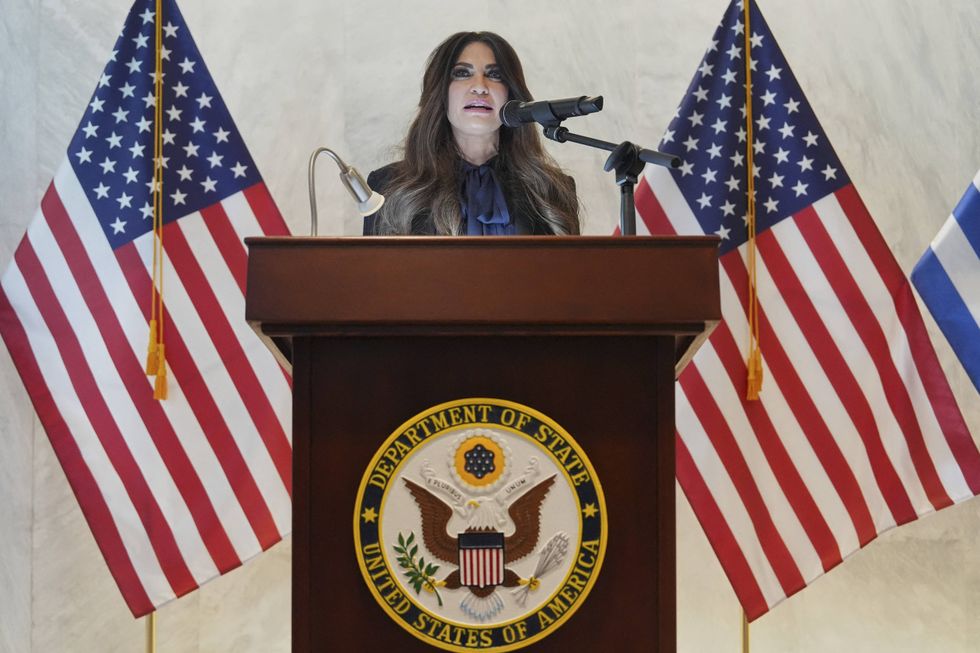
As it ran on the front
Days before her confirmation hearing, she asked Eric Deters to send $100,000 that way. On Thursday, Deters went on "Good Morning America" and gave the arrangement a name a cardholder rarely volunteers: quid pro quo. He said she offered access to Trump administration officials in exchange for the balance, that she called herself his "ride or die in Trump World," and that text messages back him up.
The receipt reads, hon: an ambassador's unpaid credit card, a donor's wire instructions, and a confirmation hearing, running on parallel tracks the Journal's reporting finally lines up end to end.…
…(cont) Run that against the public ledger. On September 2, Gallup closed a survey finding 89 percent of Americans say corruption is widespread in government, up ten points from the prior reading, the highest share Gallup has recorded asking that question. Thirty-six days later, Deters sat under studio lights and supplied one data point explaining why.
He is not the only name on that page this fall. Twenty days after Gallup closed its survey, on September 22, ProPublica put Senator Susan Collins at the center of what it called a sprawling pay-to-play operation, tying federal dollars to a donor bankrolling her campaign. Maine Senate candidate Troy Jackson called it corruption of the highest order. Collins sits in the Senate that confirms ambassadors.
Run the numbers the way the money desk runs them: a $100,000 instruction on how to make a wire transfer invisible to a bank statement, an offer of access priced against a credit card balance, and a thirty-six-day gap between a national poll and an on-camera confirmation of what the poll measured. None of this required a leak or a subpoena. The donor volunteered the words. The confirmation hearing is already a matter of public record. The AmEx statement is the kind of document any accountant could read without translation.
The gap between the Gallup finding and this week's account runs five weeks, not a season, not an abstraction. Call it what the ledger calls it: the public priced in the corruption before the particular transaction had a face attached to it. This week it got one.
“You know what gets me? She put it in writing that the wire "won't show up anywhere," and the guy turned around and put it on national television. That's not a slip, that's a business model with a card number attached. Eighty-nine percent of us already figured government runs on pay-to-play; this week somebody just signed their name to the receipt.”
“Look, people wire friends money all the time, that's not — okay, it's her American Express bill, I hear it. But nothing in a text message is a bribery statute, and "ride or die in Trump World" is just how donors talk, it's colorful, it's not a contract. Did I say contract? I meant nothing. The confirmation process worked exactly the way it's supposed to work.”
The receipts
Days before her confirmation hearing last year, U.S. Ambassador to Greece Kimberly Guilfoyle asked one of President Trump’s donors to wire her American Express account $100,000, The Wall Street Journal reported Wednesday. “You could just send it here.
· 'Corruption of the Highest Order,' Says Troy Jackson After Explosive Susan Collins Report from the morgue, 22 Sep 2026
· Perceptions of government corruption at record high: Gallup from the morgue, 2 Sep 2026
This page is a back-issue: the story as it ran, receipts as they were. The current edition is at the front. The byline is a pen name for a column drafted by a machine and checked by the editor: how this is made.