Page F116From§Eachthe evening edition — 11 October 2026
Trump priced a Republican Congress at $5,000 an adult in September, sent the first $90 out of a Medicare fund in October, and has set no date for the other $4,910.
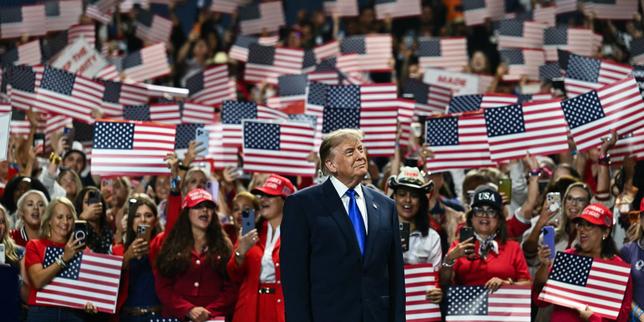
“'Trump dividend': Can promising voters a check help win an election?”, 9 October 2026 (Photo via Le Monde — the original report)
As it ran on the front
The dividend arrived this month, and it is ninety dollars.
It began in Dallas. At the Republican midterm convention, in a keynote closing the first night, a Wednesday, the president offered five thousand dollars to every adult citizen if the Republican Party holds both chambers of Congress. By Thursday the tenth of September the Washington Examiner had posted a what-to-know explainer on the budgetary and economic ramifications, which is the trade's way of saying someone had begun the multiplication.…
…(cont) The multiplication went badly in public. On Friday the eleventh Bret Baier pressed Ken Paxton on the proposal; that same day Governor Gavin Newsom called it "bulls—" and a "desperate" power grab. On Saturday, at a Kansas State Fair debate, a moderator put the proposal's $1.2 trillion cost to Senator Roger Marshall against the growing national debt, and Marshall backtracked. Sunday brought Representative Mike Lawler to ABC's "This Week," where Lawler initially avoided the question of whether the dividend had his support and offered instead, "How do you pay for it?" Representative Mike Flood said that same Sunday that the priority should be funding the troops amid the Iran war. The president, outside Air Force One, settled it to his own satisfaction: the checks will "happen 100 percent" if the GOP maintains its majority. He compared them to the $1,776 checks that went to service members.
Monday the friendly press turned. The Examiner's Guy Benson called the dividend a "disastrous idea" and observed that conservatives would scream "bloody murder" if a Democratic president offered one to maintain power. National Review called it reckless and said it echoed the sort of "socialism" the president decries. That same Monday MAGA Inc. expanded its campaign spending in Republican stronghold states and sent the vice president to Kansas to shore up Marshall.
Tuesday the fifteenth, Treasury Secretary Scott Bessent testified before the House Financial Services Committee, said he supported giving Americans the $5,000 dividends if Republicans win in November, and indicated the department was examining whether the money could go out without authorization from Congress. The Hill reported the same day that the proposal had fallen flat with Republican senators, who warn they will not support giving money to people who do not work or pay taxes. Fox News found voters calling it a publicity stunt unlikely to pass Congress.
Money that required no examination moved faster. In September the administration announced — Common Dreams carried it on the twenty-third — that it was removing at least 750,000 people from Affordable Care Act coverage because they were "fraudulently" enrolled, and KFF's Cynthia Cox said some brokers have enrolled people without their knowledge or switched their plans for a commission. The same day the Times reported that the health care and food assistance cuts in the president's signature bill were taking a toll before the election, and CBS reported Americans leaning on several forms of credit at once to cover expenses.
Then came the instalment. Late on a Friday, on social media, the president said the government would send a one-time ninety-dollar payment to more than twenty million Americans enrolled in Medicare, in early October, to help offset the cost of their monthly premiums, drawn from the Medicare Improvement Fund, which he said Congress gave two billion dollars to improve fee-for-service Medicare. The Guardian carried it Saturday the third of October. The ninety does not cover half of one monthly Part B premium. Seniors, the president said, could "rest assured" about the rest.
All together now — five thousand dollars, less ninety dollars, is four thousand nine hundred and ten dollars, due after the election on the third of November, on a date the podium has not set.
Donald Trump is promising $5,000 to every adult US citizen if both chambers remain Republican after the midterm elections on November 3. In his column, Le Monde's Pascal Riché recalls that Silvio Berlusconi and Emmanuel Macron also used financial incentives during their campaigns.
This page is a back-issue: the story as it ran, receipts as they were. The current edition is at the front. The byline is a pen name for a column drafted by a machine and checked by the editor: how this is made.