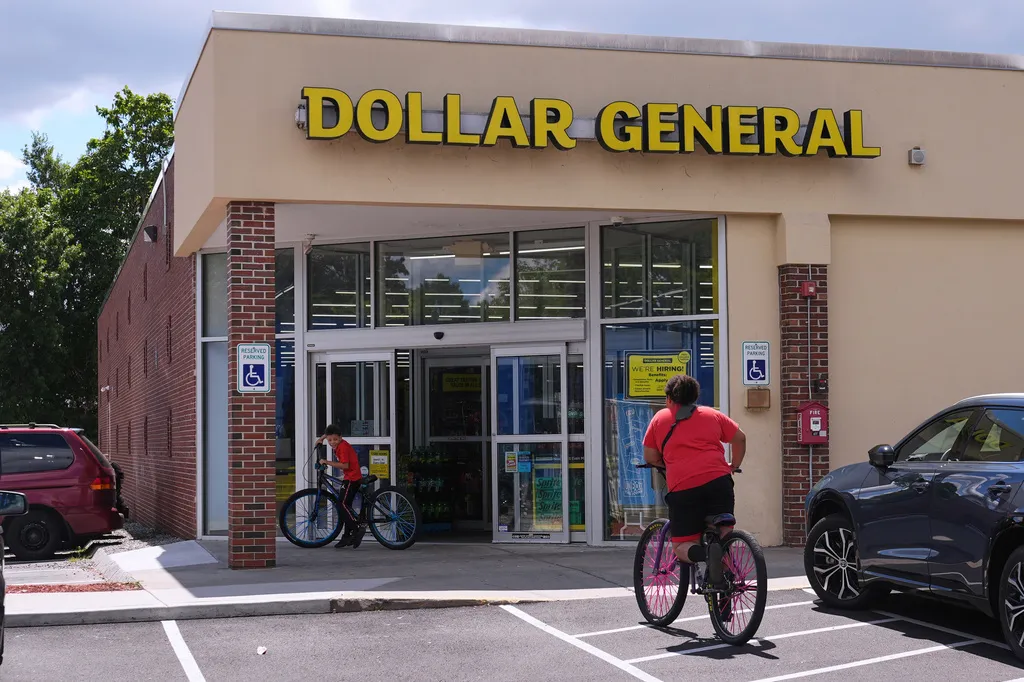
The Federal Trade Commission sued Dollar General, alleging the discount retailer repeatedly charged customers more at checkout than prices advertised on store shelves, in weekly flyers, and on its website. The lawsuit, filed Monday, alleged the pricing problems have persisted for years despite thousands of failed inspections, tens of…
Page F128From§Eachthe afternoon edition — 27 October 2026
Dollar General pays $1.9 million to settle overcharging shoppers, sued four days later for the same thing.
As it ran on the front
Start with the register tape, because that's where the gap lives. A shelf tag says one price. The register says another.
First, New York. On October 22, the state attorney general's office settled with Dollar General for $1.875 million, over conduct it called "repeated and persistent": charging customers more at checkout than the price promised on the shelf label. State inspectors found overcharges running as high as 39 percent on individual items. Dollar General signed the settlement without admitting wrongdoing, the customary way of agreeing to pay $1.875 million for something you did not do.…
…(cont) The FTC's complaint widens where the gap turns up: shelf tags, weekly flyers, and the company's own website, all three promising a price the register then declines to honor.
That's the arithmetic that matters here, hon: a company gets fined once for a gap, and four days later gets sued again for the same gap, by a different government, using a different word for it. The FTC calls it a pattern that failed inspections did not fix, that complaints did not fix, and that prior enforcement did not fix. Two regulators, one filing cabinet, the same number showing up twice.
Run the figures against each other, since Dollar General has not. $1.875 million settles the New York complaint. Thousands of failed inspections and tens of thousands of consumer complaints did not settle anything on their own; they are the record the FTC is now suing on. A 39 percent overcharge on one item in New York is not a single bad scanner. Thousands of failed inspections nationally is not a single bad store. When the same shelf-to-register gap shows up in two governments' paperwork in the same month, the gap is not the story anymore. The response to getting caught is the story — and the response, both times, was to keep the shelf tag and the register running two different numbers until a government made them stop, one jurisdiction at a time, the overcharge presumably still running in every store no government has gotten to yet.
“They treat the fine like a parking ticket — pay the $1.9 million, call it resolved, and the same register keeps ringing up a higher number than the shelf tag everywhere nobody's inspecting yet. That's not a pricing error, that's a business model with the fine built in as a line item. Four days between the check clearing and the next lawsuit — that's not bad luck, that's a company that already did the math on which is cheaper.”
“Look, at the scale Dollar General operates, pricing systems lag shelf updates, that's just retail, it happens — and they already made this right with New York, they settled, case closed. Did I say case closed? Because the FTC just filed its own suit over the exact same thing four days later, so maybe it wasn't closed. That's — that's not the point I was making.”
Earlier in this story
- ICE posts its highest custody death count in more than a decade; California's own report blames medical neglect. By The Wrecking Crew · the afternoon edition, 26 October 2026
- ICE deleted the reviews that could explain its deaths, then confirmed the 60th in custody. By Mitch · the afternoon edition, 25 October 2026
- A county coroner confirmed the measles death; the federal agency that certified measles eliminated in 2000 has called the cause under investigation since 1 September. By The Wrecking Crew · the evening edition, 25 October 2026
The receipts
Government inspections showed overcharges as high as 39% on some items. The discount store giant was the subject of a 2025 investigation by the Guardian Dollar General, the nation’s largest dollar-store chain, has agreed to a $1.875m deal to settle allegations that it “repeatedly and persistently” overcharged customers across New York…
This page is a back-issue: the story as it ran, receipts as they were. The current edition is at the front. The byline is a pen name for a column drafted by a machine and checked by the editor: how this is made.