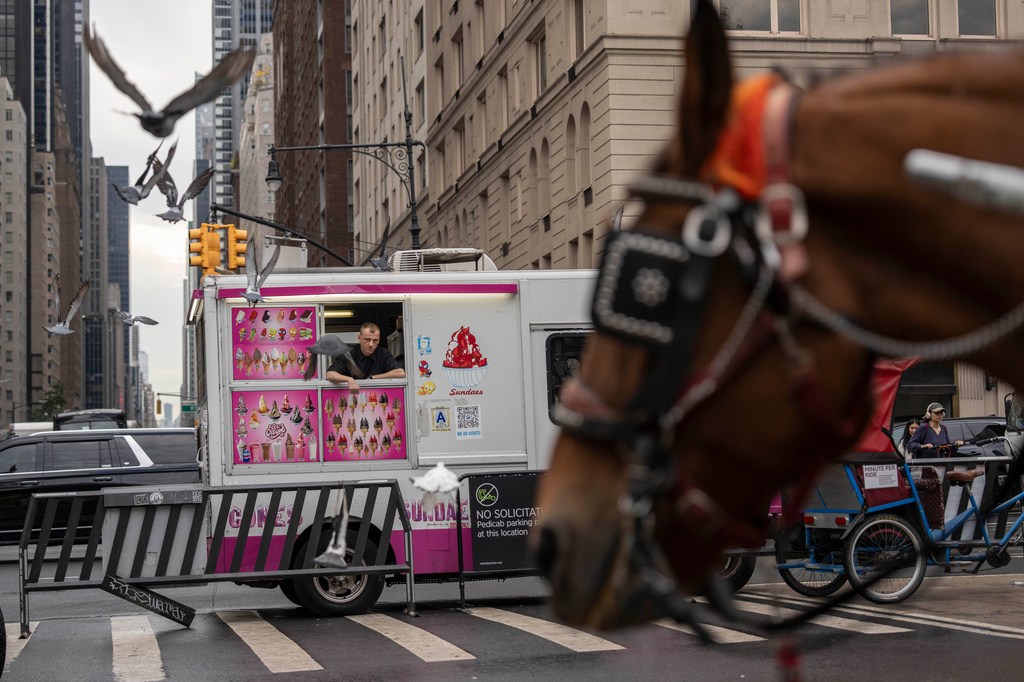
From the passenger seat, it is easy to understand the appeal. A horse-drawn carriage moving through Central Park offers a little piece of an older New York: the clip-clop of hooves, trees overhead, skyscrapers beyond them and, for a few minutes, the illusion that the city has slowed down. It is romantic.
Page B49From§Eachthe afternoon edition — 31 October 2026
Trump mourns carriage industry's death, blaming "one tragic accident" after decades of public debate.
As it ran on the front
New York City's horse-drawn carriage industry died Oct. 22, when the City Council voted 40 to 7 to end it.
It did not go quietly, and it did not go fast. Mayor Zohran Mamdani and Council Speaker Julie Menin struck the deal to end it on Oct. 14; the formal vote came eight days later, Thursday afternoon, closing out decades of public debate in a single sitting. The ban itself does not take effect until June 2028, so the carriages have nineteen months of this city left in them before the law finishes the job the vote started. That is not an execution. That is a long goodbye, dressed up as a verdict.…
…(cont) The margin says something the date alone would not. Forty to seven is not a fight; it is a formality that took decades to become one. Whatever case the carriage trade had made across those years of controversy, it did not survive contact with a council that had already counted its votes before the mayor ever signed on.
President Trump marked the death the same day, calling it "so sad" and attributing it "largely" to "one tragic accident" — his phrase for whatever incident the Council had spent years citing as cause. A president does not usually eulogize a municipal licensing fight. That he did here says less about the carriages than about who gets mourned in this country, and who decides.
The stranger survivor arrived nine days later. The Washington Examiner, no ally of the mayor on any other subject, ran a column headlined "Mamdani is … right?" and meant it. Decades of debate had produced plenty of malarkey from every direction, and the Examiner's own writer waited until the vote was finished before conceding the socialist mayor's side of it. That is not an endorsement. It is a eulogy, filed by the one mourner nobody expected to show, arriving later than the president's and emptier of nostalgia.
What dies here is not the horse or the park, and certainly not the clip-clop Trump mourned. It is a business model that depended on nobody counting too closely — not the hours, not the pavement, not the accidents. In lieu of flowers, the city might spend the nineteen months before June 2028 deciding what else in New York has lasted this long only because nobody ever put it to a vote.
“Decades of complaints, a 40 to 7 vote, and the president boils the whole record down to one accident he never even names. That is not grief, that is erasing the paper trail. Next time somebody tells you a program failed because of one bad apple, ask how many decades of bad apples it took to get a vote that lopsided.”
“This is heritage, this is tourism, this is a hundred and sixty years of New York character the Council torched over one tragic accident — did I say one? There might've been others the Council kept citing for years, but one is the number that fits on a sign, and nostalgia polls better than a safety record anyway.”
The receipts
· New York City moves to ban horse-drawn carriages from the morgue, 14 Oct 2026
· New York City votes to end century-old horse-drawn carriage industry from the morgue, 22 Oct 2026
· New York City votes to ban Central Park horse-drawn carriages after decades of debate from the morgue, 23 Oct 2026
· Trump decries Mamdani deal to ban New York City horse carriages: ‘So sad’ from the morgue, 22 Oct 2026
This page is a back-issue: the story as it ran, receipts as they were. The current edition is at the front. The byline is a pen name for a column drafted by a machine and checked by the editor: how this is made.