Federal officials laid out their mitigation plans a day before the U.S. Army was set to do a controlled explosion of nearly five tons of lead azide.
Page A244From§Eachthe afternoon edition — 24 November 2026
Army says detonating five tons of its own decaying explosives is safer than leaving them alone.
As it ran on the front
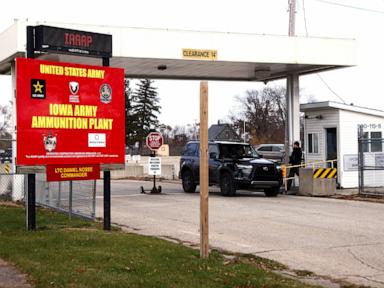
Follow the drums, again, because the drums have not moved. Sixty-eight of them, lead azide, sat in bunkers at the Iowa Army Ammunition Plant near Middletown for about twenty years, until this year, when the Washington Examiner reported the material had begun to crystallize into something the Army itself now says cannot be moved. That is the first filing, and it only gets harder to read from there.
On 20 November the Army postponed its first scheduled detonation after what The Hill called "pleas from Iowa lawmakers" of both parties, who said they had been given short notice. Acting Army Secretary Adam Telle called public safety "the Army's top priority" and ordered Army Materiel Command to stand down for the day. That same week, two environmental groups — the Iowa Environmental Council and the Sierra Club's Iowa chapter, represented by Earthjustice — filed suit Thursday against the EPA, arguing the detonation could expose thousands of families to toxic dust. A federal appeals court agreed enough to stay the EPA's permit, then went further: by the weekend it had halted the detonation indefinitely, a stay significant enough that CBS News covered the halt as its own story.…
…(cont) Monday, the same court declined to keep it halted. The order simply lifted. That is today's filing, and all together now — the sequence runs: postponed for lack of notice, sued over toxic dust, stayed, halted indefinitely, cleared.
Hours later, Telle held a press conference and agreed with her framing from the other direction: a "controlled, mitigated detonation," he told reporters, is "preferable for public health and safety." ABC News reported the mitigation plans the same day, laid out one day ahead of Wednesday's blast.
Read those two statements side by side and they say the same thing from opposite ends: the nearly five tons of lead azide are dangerous, and the Army's plan to detonate them is the safer option on offer. Neither statement explains who decided, twenty years ago, that a bunker in Middletown was the place to find out how dangerous crystallized lead azide could get. The detonation is scheduled for Wednesday morning. That is the next date on the calendar. The file does not yet say what Thursday looks like.
“Nobody built a plan to store live explosives for twenty years — that's called forgetting, not storage. Now that the drums crystallized on the Army's own watch, blowing them up gets sold as the safety measure, not the bill coming due for the neglect. Families near Middletown don't get a controlled version of twenty years of somebody else's job going undone.”
“A managed, professional detonation is safer than an uncontrolled one — that's just physics, the Army didn't create the danger, the drums did. Crystallizing drums. Which the Army stored. In bunkers it owns. For twenty years. Okay, when you lay it out like that it does sound like the same outfit grading its own emergency — did I say that? That's not landing the way I wanted.”
Earlier in this story
- Army will detonate 9,500 pounds of lead azide Wednesday; Trump assigns any "death or destruction" to the Democrat By Mitch · the evening edition, 24 November 2026
- Trump defers to the court his Army defied, then blames the incoming governor for any "death and destruction." By The Lodgers · the afternoon edition, 23 November 2026
- Army cites safety to detonate the explosives a court cited safety to stop. By The Lodgers · the morning edition, 23 November 2026
- Army claims emergency exemption from the order pausing its explosion, tells Iowans any fallout rinses off By The Lodgers · the afternoon edition, 22 November 2026
The receipts
Two environmental groups are suing the Environmental Protection Agency (EPA) in a bid to stop the Army from detonating thousands of pounds of explosive lead material at an Iowa ammunition plant, arguing the activity could expose thousands of families in the surrounding communities to toxic dust. The Iowa Environmental Council and the…
Gov. Kim Reynolds (R-IA) said on Tuesday she is taking the military’s warning about an uncontrolled explosion of degraded lead azide at the Iowa Army Ammunition Plant “seriously” ahead of Wednesday’s planned detonation.
A federal appeals court was considering a long-term halt on Friday to a plan by the US Army to detonate about five tons of aging, toxic lead-based explosives at a munitions plant near Middletown, Iowa, after issuing a temporary suspension of the US Environmental Protection Agency's permit, which had been for Monday. In a one-sentence…
Acting Army Secretary Adam R. Telle held a press conference in Iowa to discuss plans for the controlled detonation of toxic materials. He stressed that a "controlled, mitigated detonation" is "preferable for public health and safety."
A federal appeals court on Monday declined to block the Army from detonating explosives containing lead azide at a munitions plant in Iowa.
Acting Army Secretary Adam Telle announced he would be postponing Friday’s detonations of lead azide barrels in Iowa amid heavy pushback from lawmakers who say they were given short notice about the planned explosions. “Public safety is the Army’s top priority, and I have directed Army Materiel Command to postpone tomorrow’s controlled…
For about 20 years, 68 drums of lead azide, an explosive used to make detonators, sat in bunkers at the Iowa Army Ammunition Plant in Middletown, a small town near the Mississippi River in southeastern Iowa. This year, the material began to crystallize, leaving it so unstable that the Army says it can’t be moved, […]
This page is a back-issue: the story as it ran, receipts as they were. The current edition is at the front. The byline is a pen name for a column drafted by a machine and checked by the editor: how this is made.