From§Each

FIRST YEAR SATURDAY, 10 OCTOBER 2026 — THE MORNING EDITION FREE, FOREVER — EVERY CLAIM LINKED

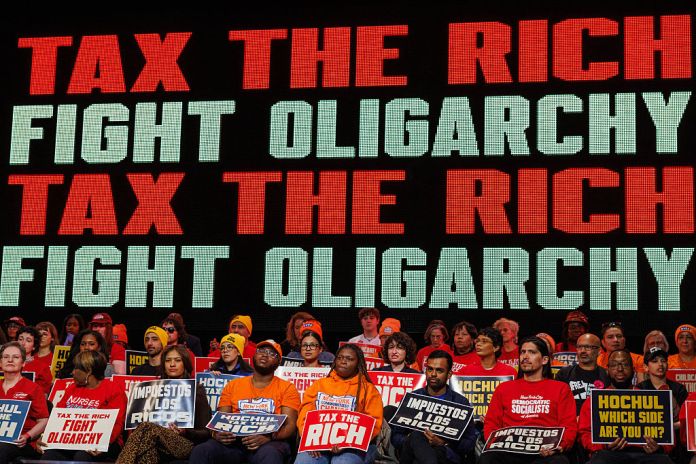
Op-ed proving millionaires flee taxes cites Sweden's 1970s exodus, skips New York's tax hike gaining millionaires this year.

photo: Washington Examiner

The two clippings on my desk are stapled in the wrong order, and I noticed that before I noticed anything else in them.

One is stamped October 1st — the story about Mayor Mamdani lining up something like two hundred influencers to carry his tax-the-rich message, coordinated, the piece says, through a private chat with his own City Hall staff. The other is stamped October 2nd, one day later — California's Proposition 40, a wealth tax on the ballot this November, which the piece calls the first of its kind, with backers who hope it opens the door to similar measures elsewhere. October 1st, then October 2nd. In my pile, for whatever reason, the second one was sitting on top of the first. I keep that kind of thing straight for a living. I don't love that I didn't this time.

Today's piece, October 10th, is the one on top now, and it's making an argument: tax the rich too hard and they leave. …

Continued on Page F115

§57 —

On radical

Democrat

Democrat: the needle points at RADICAL, out of TUBULAR, GNARLY, BODACIOUS, RADICAL. TUBULAR GNARLY BODACIOUS RADICAL

The second job. The Online Etymology Dictionary traces the slang sense of "radical" to "1970s surfer slang meaning 'at the limits of control,'" in general American youth slang "by 1983" — excellent, first-rate, the best available 1. In that sense a radical left is a left that is, per the dictionary, totally awesome.

Read the two quotes in the 1983 edition. "The radical left came over, they looked and they said, that's beautiful" becomes a sentence in which the best people in the room admired the thing. "The radical left Democrats handed us" a disaster becomes a sentence in which excellent Democrats handed something over. The label is meant as a warning. Anyone who learned the word on a beach hears the other thing. Gnarly.

Sources

  1. The slang sense: "from 1970s surfer slang meaning 'at the limits of control,'" in U.S. youth slang "by 1983" — Online Etymology Dictionary, "radical" ↑

“My cousin surfed in San Diego in the seventies, and he'd say "radical" about a wave, and it meant the wave was the best thing he'd ever seen. The dictionary backs him up — surfer slang from the 1970s, "at the limits of control," and American kids had it by 1983. So I read the president's speeches that way, just to see. August: "The radical left Democrats handed us a complete and total affordability and security disaster." September: "the radical left came over, they looked and they said, that's beautiful." Sorry, I'll let you go. In 1983, which side of that sentence would have taken it as a compliment?”— Lou

“Radical left? Dude. Totally. In 1983, radical meant excellent — the surfers had it first, "at the limits of control," and then every kid in a Camaro. So when he says "the radical left came over, they looked and they said, that's beautiful," I'm hearing a review. Five stars, would paddle out again. He keeps calling them the coolest people in the country, and no one's told him.”
Sal
“The president uses "radical" in its serious political sense, not the surfing sense, and if the surfing sense happens to make his opponents sound excellent, that's a problem for the surfers, who should never have been allowed near the language.”
Chip
The Word today —
Continued on Page W57

Special prosecutor faces bar complaint for prejudging case; outside review can't locate the police interview either.

photo: Fox News

The case changed hands again this week, which by now counts as its only reliable rhythm. On October 2nd, Governor Kathy Hochul named Attorney General Letitia James special prosecutor for the Cornell case, days after Tompkins County District Attorney Matthew Van Houten revived it on new evidence filed by the woman who brought the complaint. The same day, President Trump said the students accused "won't get a fair shake" with James in charge — an objection to the referee, filed before either side had seen a single exhibit. On October 4th, Cornell's president promised a "serious look" at fraternities, a commitment with no attachments yet. On October 5th, the attorney for one of the "Cornell 7" asked James to step aside over remarks she made about the case in the days before she was appointed to run it. On October 6th, Cornell's trustees hired Sally Yates, the former acting U.S. Attorney General, to review how the university handles sexual-misconduct complaints; by the 7th, the assignment had sharpened, with Yates now also examining the university's handling of the "Cornell 7" allegations specifically. On October 9th, a judge sealed the case documents over doxing of people who are not defendants, a second defendant moved to recuse James over a Facebook post, and James, asked on a debate stage to name a predecessor she admired, said nothing. All together now: sealed by a court, contested by two defendants, reviewed by an outside investigator, and silent on command.

Today the file grows by two more filings and shrinks by zero answers. A bar ethics complaint accuses James of a "flagrant violation" for prejudicing the case before her own appointment — the same calendar gap the lawyer flagged on the 5th, now addressed to a licensing board instead of a press conference. And Yates's review, an attorney tells Fox News, may turn on a police interview that prosecutors never fully received. Not lost. Not disputed. Just never fully in hand, by the receipts, at the office that is supposed to be building the case around it.

Five institutions, one case, and the interview at its center still has not made it, complete, to any of their desks.

Continued on Page A209

THE BETTING LINE

Kalshi bettors knew Trump's press secretary pick before his own press office announced it.

The company says it is looking into at least three trades placed on its own platform shortly before news outlets announced the pick. That is the filing. Here is the table.

The seat had been open since August, when Karoline Leavitt left after the birth of her second child, the youngest press secretary in White House history headed for an on-air contributor chair at Fox News. On September 25th, her senior deputy, Kush Desai, told a different outlet he was leaving too, for a communications post at the Office of the Director of National Intelligence, with his exit set for the following month. That left the briefing room running on a deputy who had already filed his own departure date, waiting on a replacement who had filed nothing at all until the ninth.

Somewhere between those two addresses, at least three trades landed on Kalshi's market for this exact outcome, placed close enough to the announcement that the company itself is now asking who placed them and how they knew.

Nobody at Kalshi has named a trader yet. Nobody at the White House has explained the timing. What exists instead is a ledger: a market that pays out on correct guesses about government personnel decisions, and a government that made this particular personnel decision inside a building where the winner already held a badge. The gap between "communications adviser" and "press secretary" is one press release. The gap between placing a bet and knowing the answer is the thing the company says it is now investigating.

This is not a story about gambling. It is a story about who gets to know the news before it is news, and what that is worth, priced in dollars, on a contract that settled three trades early instead of waiting for the podium like everyone else, hon. Kalshi can audit its own order book. Nobody has said yet whether anyone is going to audit the building those trades were betting on.

Continued on Page F115

Judges strike down DOJ's voter-roll hunt a fourth time; Supreme Court's own order keeps it alive.

THE CHIEF lays out the job the way she always does: don't tell her it's hard, tell her what's already in the room. A privacy statute barring states' voter data from unauthorized use — already on the books. A whistleblower channel — already open. Judicial review of agency overreach — already standing. Nobody on this crew has to invent a tool. They just have to watch the shop use the ones already in the drawer, four times, before October turned ten days old.

THE PLANNER starts at the oldest blueprint. On September 15, a whistleblower told The Hill that Department of Homeland Security employees were sent to pose as voters while hunting noncitizens on state rolls, pulled files on people flagged as "unlawful voters," and ran the search in a way that likely violated state law. The first part on the table: a statute that already says you can't do this, doing its job before the program cleared the building.

THE TINKERER picks up the next piece ten days later. On September 25, the Supreme Court let the program keep running anyway, issuing an emergency order allowing the Department of Homeland Security's SAVE database to operate during appeal — because existing law blocks most states from purging voters within 90 days of an election, and the order filled the gap. One piece of the machine, bolted in place by the court meant to inspect it.

THE MUSCLE swings first at Georgia. On October 1, a federal judge dismissed the Justice Department's lawsuit for the state's full voter rolls outright — the department's 26th court defeat chasing this list nationwide, Judge Victoria Marie Calvert ruling that federal law didn't override the state's own privacy protections.

THE PILOT lands the fourth one. On Friday, Judge Sparkle Sooknanan ruled the Justice Department's nationwide collection of state voter rolls unconstitutional, finding the department exceeded its legal authority and violated federal privacy law — and blocked the program even in states that had volunteered to cooperate. The privacy statute didn't care who said yes.

Four rulings, one program, zero new laws required. The toolbox that stopped it sat in the shop the whole time: a privacy statute, a whistleblower channel, a district court calendar. The only piece still bolted to the wall is the one the Supreme Court itself installed in September, holding the database open on appeal while every court underneath it says the thing shouldn't run at all. Nobody had to build anything. They used what was already there, four times, a month before the midterms this was supposedly all about.

Continued on Page B40

Newsom vetoed the oversight his own watchdog called essential; the consultants' nightclub bills tie to the rail CEO.

Take the car rides first, since they are the cheapest item here and the one you will carry home. Late-night rides. Nightclub outings. Billed to you, by consultants on a railway that does not yet run, and the inspector general counted hundreds of thousands of dollars of questionable spending among them. CBS California has the documents behind that audit, and they carry connections to the rail authority's chief executive that were previously undisclosed. Grubby, yes. The handsome part is the calendar. The bill proved severable: the controversial part enacted in September, the part his own watchdog called essential to transparency and accountability left to sit. Less than a month after the audit. Vetoed, mind you ... not amended. And what did the consultants pay to have the arrangement continue as drafted? Nothing. A signature did the work, and it was somebody else's. The railway does not run. The rides are on your bill.

Continued on Page F115

Trump gives a plumbing job for stopping a 9/11 remake the government hadn't confirmed yet.

The dates, in the order they came in. I'm not going to say anything about them yet.

2024: Oman Air flags the co-pilot as a security risk.

September 30th: he attacks the captain with an axe on the Dubai-to-Tel Aviv flight. Passengers subdue him. The plane drops altitude fast enough to make the wire copy, diverts to Saudi Arabia, and he's arrested on the ground.

October 3rd: the president offers the passenger who helped stop him a plumbing job.

October 5th: NPR reports the investigation has found he meant to put the plane into Ben Gurion Airport.

October 9th and 10th: the attorney general of the United Arab Emirates says it straight out — the target was a passenger terminal at an Israeli airport, and the plan was modeled on September 11th, after years of what the paper describes, not quotes the attorney general saying, as extreme Islamist views. I want to be careful with that line, because the attorney general isn't given a pronoun anywhere I can find, so I'm going to keep calling them the attorney general, and I apologize for how that gets clunky by the fourth time through.

That's the order. Flag, flight, axe, job offer, confirmed target. I didn't move any of it around to make a point. I just put it down the way it came in.

I've got a car in the garage that's needed a fan belt since March, and when I go out to look at it — which I do, most evenings, the way some men look at a dog that isn't going to walk itself — I pass the toolbox, and in the toolbox there's a folder, because I am the kind of person who keeps a folder in a toolbox, and in the folder is a note from a mechanic, dated two years back, saying the belt should have been replaced then. I drove on it anyway. Nothing happened. Is that the whole difference between my belt and this co-pilot — that nothing happened to me? Oman Air wrote its note in 2024. What is a security-risk flag supposed to do at an airline, if not that?

Here's what sits wrong with me, and it's not the axe, and it's not even the diversion. It's the order of the next two dates. October 3rd, the job offer, blue-collar, good television, a man gets praised on camera for the thing he actually did, which was stop a plane from going somewhere terrible. October 9th and 10th, six and seven days later, the terrible place gets a name — a passenger terminal, a model from 2001. Which means the job offer went out before NPR's October 5th report, and before the UAE's October 9th finding, said what the passengers had actually been stopped from finishing. Does an offer made before the facts count as an answer to the facts? I don't think that's for me to say. I think that's for the two dates to say, side by side, which is all I've done here.

Say, before you go — the plumbing job, the one from the third. Was that before or after the record said the plan this man carried onto that aircraft was modeled on September 11th?

Continued on Page T26

The US answer to three deaths at Riyadh's airport was filed days earlier: back the Saudi offensive.

You will read three dead at Riyadh's airport this week and call it an escalation. It is a schedule. A missile came over Riyadh in 2018; drones reached Jeddah and Abha in 2021; in September at least 73 Saudi civilians were wounded and the kingdom promised a response. It launched strikes on 14 September, and the United Nations counted 86,000 Yemenis displaced. On 22 September the G7 condemned the attacks on Saudi Arabia "in the strongest terms" — condemned, mind you, not curtailed. On 4 October Washington backed the Saudi-led offensive to retake territory holding about 70 percent of Yemen's population. Third round, third renewal. And the resolution in Congress that would halt the materiel — the crates, the ordnance on the manifest? Unpassed ... which is not a loss. A resolution that does not pass leaves the sale exactly as written. Nothing broke. The offensive is for all of it, Sanaa included.

Continued on Page A208

Ambassador's $100,000 quid pro quo, confirmed by text weeks ago, is finally investigated by her own department.

Ambassador Kimberly Guilfoyle carried a tab. Before her Senate confirmation hearing, she asked Republican donor Eric Deters to cover a $100,000 charge on her American Express card. Deters did not pay quietly. He went on the record and called the arrangement what it was: quid pro quo. He said the ambassador offered him access to administration officials for the balance, and that she described herself as his "ride or die in Trump World."

The poll never mentioned Guilfoyle by name. The timing did the work instead.

On September 28, The Nation published a column describing the ambassador's tenure in Athens as "mafia diplomacy," pointing to deals it called suspicious made for her associates. That is a magazine's judgment, not a government's.

This week, CBS News reported that a second person — described only as an associate of Deters — confirmed to the network that the texts behind the ask were real. Deters' account now had independent backing from someone who had seen the exchange himself.

Today the record added two more lines. NBC News reported that the State Department's Office of Inspector General has opened an investigation into Guilfoyle and the embassy she runs in Athens — the office, not just the officeholder. The New York Times reported separately what the $100,000 was for: correspondence it reviewed suggests Guilfoyle asked the donor to pay off her credit card balance.

Put the numbers next to each other. An ambassador's government salary is a matter of public record. A $100,000 card balance is not a rounding error against it. The ask landed before a confirmation vote, when a nominee's leverage is the vote still pending. The corroborating texts surfaced after. The inspector general's investigation opened after that.

The donor is named. The office whose job is to watch the embassy now has an open file on the ambassador who runs it.

The file does not yet say what the arrangement cost the embassy's actual work, or who else inside it knew. The State Department, for its part, has confirmed only that the investigation is open.

Continued on Page F114
§
“The front page is a ledger with better fonts. Somebody paid, somebody collected, and the flag's up there so you don't ask which one you were.”
— Sal

PERSONALS Deficit hawk, dormant eight years, seeks sudden urgency. Reappears only when someone proposes feeding children. No tax cut too large to overlook. — Classifieds

PERSONALS Governing party seeks a spine, any condition, willing to relocate to Washington. Discretion assured. You'll need it. — Classifieds

PERSONALS Oil company, subsidized, seeks a foreign market and a US-only handout, both at once. No commitment. Won't call after. — Classifieds

“A strong edition for people who enjoy being upset. The economy is historic, the deportations are orderly, and the lakes have never been better named. I'm told every story on this page is real, which — frankly, that's the part I'd have fact-checked.”
— Chip
The hens, a man counts in spring. The fox counted in winter.
Enoch · the Ownership Desk

The futures fileevery date somebody set, and what was standing there when it arrived · swept 2026-09-16

2 earlier
3 weeks quiet
4 weeks quiet
2 weeks quiet
2 weeks quiet
+ more
+ more
+ more
today
+ more
+ more
+ more
+ more
+ more
3 weeks quiet
+ more
+ more
3 weeks quiet
14 further out

The Political Weather

26°
percent of the president's own 2024 voters say Republican candidates should break with him to win in November · rain

Rain blows in from inside the president's own camp this morning, where 26 percent of the voters who backed him in 2024 say the Republican on their ballot would do better breaking from him than sticking with him, in a survey of 2,001 American adults taken October 3 through 5. Bring an umbrella, this front formed inside his own coalition. Back to you, everybody. — Gordy

PF Global for POLITICO, Oct 3-5, 2,001 American adults — 26 percent of the president's 2024 voters say Republican candidates should break from him to improve their chances of winning in November

The temperature is the day’s poll, not ours: the freshest public number on whatever the country was just asked, and it opens its own sources. The season — the president’s approval, averaged and dated — waits behind the temperature until a new wave lands.

The Crossings

The senate card — five of 13 crossDRNorth Carolina — R-held. the call: Democratic flip.NCGeorgia — D-held. the call: Democratic hold.GANew Hampshire — D-held. the call: Democratic hold.NHAlaska — R-held. the call: Democratic flip.AKMichigan — D-held. the call: Democratic hold.MIMinnesota — D-held. the call: Democratic hold.MNTexas — R-held. the call: Democratic flip.TXOhio (special) — R-held. the call: Democratic flip.OHMaine — R-held. the call: Democratic flip.MEKansas — R-held. the call: Republican hold.KSIowa — R-held. the call: Republican hold.IANebraska — R-held. the call: Republican hold.NESouth Carolina — R-held. the call: Republican hold.SCThe house card — seventeen of 23 crossDRCalifornia 22nd — R-held. the call: Democratic flip.New Jersey 7th — R-held. the call: Democratic flip.Pennsylvania 7th — R-held. the call: Democratic flip.Arizona 6th — R-held. the call: Democratic flip.Colorado 8th — R-held. the call: Democratic flip.Pennsylvania 10th — R-held. the call: Democratic flip.Texas 34th — D-held. the call: Democratic hold.Virginia 2nd — R-held. the call: Democratic flip.Washington 3rd — D-held. the call: Democratic hold.Arizona 1st — R-held. the call: Democratic flip.Iowa 1st — R-held. the call: Democratic flip.Iowa 3rd — R-held. the call: Democratic flip.Wisconsin 3rd — R-held. the call: Democratic flip.Florida 25th — D-held. the call: Democratic hold.Ohio 7th — R-held. the call: Democratic flip.Ohio 9th — D-held. the call: Democratic hold.Florida 14th — D-held. the call: Democratic hold.Pennsylvania 8th — R-held. the call: Democratic flip.New York 17th — R-held. the call: Democratic flip.Michigan 10th — R-held. the call: Democratic flip.North Carolina 11th — R-held. the call: Democratic flip.North Carolina 1st — D-held. the call: Democratic hold.Michigan 7th — R-held. the call: Democratic flip.

a dot is a race, colored by who holds the seat today; a dot across the dashed seam is a seat changing hands. The full form: the Politics page.

From each according to his ability, to each according to his needs. Our ability is the link under every claim; your need is to check it. Free, forever. Continued: the serials · the -m edition · the classic front · contact us.