From§Each

FIRST YEAR TUESDAY, 03 NOVEMBER 2026 — THE AFTERNOON EDITION FREE, FOREVER — EVERY CLAIM LINKED

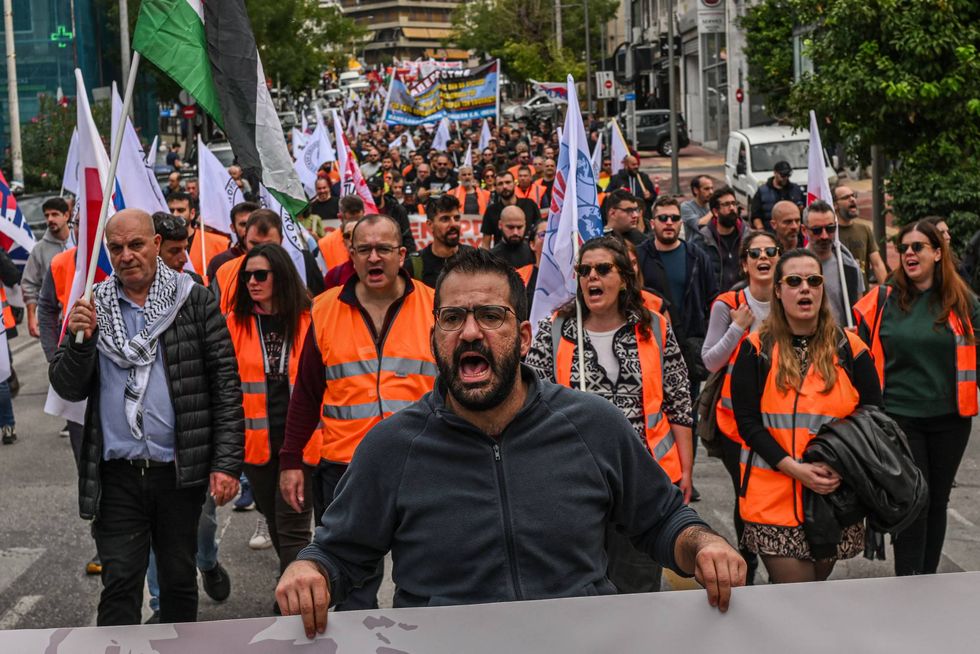
Italy answers a dockworkers' strike against war by deploying troops against them.

photo: Common Dreams

On Oct. 15, in Rome, the World Federation of Trade Unions stood up at a press conference and launched something it called the International Day of Action of Dockworkers and Port Workers Against War and Militarisation. Two weeks later, the plan became a fact on the water.

Oct. 30 arrived, and 113 ports in 22 countries on six continents stopped moving. Workers World called it one of the largest internationally coordinated strikes in world history; the organizers quoted by Common Dreams called it the largest coordinated port action ever, bigger than the day of action they'd run in February. The banners said "We won't work for war" and "Ports for peace — jobs with dignity." The claim was not abstract: the unions said commercial ports fuel militarism, and on Oct. 30 they declined to fuel it.

In Italy, the stoppage did not stay on the docks. …

Continued on Page A227

§81 —

On Election Day

Democrat

Democrat: the needle points at 23RD OF 38, out of TUESDAY, TOO BUSY, 5 POINTS, 23RD OF 38. TUESDAY TOO BUSY 5 POINTS 23RD OF 38

Before any of this year's laws, the oldest obstacle was the date itself. The United States ranks 23rd of 38 OECD countries in voter turnout, and most of the countries above it vote on a weekend or on a declared public holiday 1. More than sixty percent of elections worldwide are held on a weekend, Sunday most commonly 2. Twenty-six percent of Americans who did not vote gave the reason as being too busy — work, school, obligations 1. An analysis of thousands of international elections found turnout rises on average five to six points when a national election moves from a weekday to a rest day 2.

So the fix is known, it is measured, and it has been introduced: the Election Day Act would make today a federal holiday, and no bill of its kind has ever cleared Congress 3. Tuesday was chosen in the 1840s around a farm calendar and a day's travel to the county seat. It has outlived the horse. Both of today's files are about how many hours a person has to spend to cast one vote — and only one of the two got a legislature's attention this year. Polls are open. Go stand in the line.

Sources

  1. The United States ranks 23rd of 38 OECD countries in turnout, most of which vote on a weekend or national holiday; 26 percent of American nonvoters reported being too busy because of work or school — Institute for Responsive Government, What Other Countries Can Teach Us About Turnout ↑
  2. More than 60 percent of elections worldwide are held on a weekend, Sunday most commonly; an analysis of thousands of international elections found turnout rises five to six points on average when polling moves from a weekday to a rest day — The Conversation ↑
  3. The Election Day Act, H.R. 154, 119th Congress, would establish Election Day as a federal holiday; no bill of this kind has cleared Congress — Congress.gov ↑

“Election Day. I've got two files and they're both about how hard we make this. First file: we vote on a working Tuesday, more than sixty percent of elections worldwide are on a weekend, we come in twenty-third of thirty-eight in turnout, and twenty-six percent of nonvoters said they were too busy with work or school. Move it to a rest day and the research says turnout goes up five or six points. Second file: nine states passed twelve new restrictions in the first four months of this year, on top of thirty-one from last year still in force today. Sorry, one thing before you go. The first file is a problem nobody fixed in two hundred years. The second one took eighteen months. We move fast when we want to.”— Lou

“It's Tuesday. Go vote. And while you're standing in that line on your lunch break, remember that we're the ones who picked Tuesday — a farm calendar from the eighteen hundreds, kept because nobody ever moved it. Sixty percent of the world votes on a weekend. We rank twenty-third out of thirty-eight. A quarter of the people who don't vote say they were at work. There's a bill to make today a holiday. There's always a bill. Go vote anyway, that's the whole point, they're counting on the line being annoying.”
Sal
“Election Day has been Tuesday since 1845 and that continuity is part of what makes it meaningful, and I'd add that if someone genuinely cannot find time to vote across a two-week early voting window, the issue may be one of priorities rather than of access.”
Chip
The Word today —
Continued on Page W81

Army Secretary loses Pentagon turf war in August, hired by OpenAI in November to modernize national security

You will have been told this is a man landing on his feet, and you will want to be pleased for him. Do not be. Nothing here failed. On the thirty-first of August the Army Secretary submitted his resignation after months of turf war with Defense Secretary Pete Hegseth — turf, mind you, not policy — and on Monday OpenAI announced him as senior counselor for national security modernization. A new role, the company says. New: nobody has held the chair before him, so nobody can tell you what the chair is for, beyond how artificial intelligence can be used. Used by whom the announcement does not say.

And what did the company buy? Not a patent. Not a product. The top of the Army and a college friendship with the Vice President — Driscoll is a college friend of JD Vance, as it happens — which is goodwill, the one asset on a buyer's books that cannot be weighed, shipped, or pointed at. Over two months between the resignation and the hire. Two.

The public paid for the chair he sat in ... and was not asked about the chair he sits in now. OpenAI announced the hire in writing, under its own name. Nothing was hidden.

Continued on Page F133

Investigative Reporting

THE RATION LINE

Chapter 2: A Single Article

Keep the loaf on the table and pick up something heavier: a bound volume from the International Court of Justice, the United Kingdom's case against Iran, filed in 1951. Toward the back, translated into English, is a law short enough to read before your tea goes cold. It has one sentence. "In the name of the prosperity of the Persian nation, and with a view to helping secure world peace, we the undersigned propose that the oil industry of Persia be declared as nationalized throughout all regions of the country without exception, that is to say, all operations for exploration, extraction, and exploitation shall be in the hands of the Government." Read the last six words again. In the hands of…

Continued on the Investigative Reporting page

SANCTIONS SOUGHT

Justice Department answers five court losses by charging 63 voters, seeking sanctions on its own analysts.

The Justice Department told the country that 190,000 people on California's voter rolls were not citizens. That number did not survive contact with a court. All together now, follow the subtraction: 190,000 became 20,000, an eighty-nine percent cut, and an outside count of what remained found four in ten of those names were wrongly flagged. The department built an emergency lawsuit on the smaller number anyway, asking California to set aside ballots from the 20,000 named voters until someone could verify their citizenship — the verifying was supposed to happen after the lawsuit, not before it.

The courts did not agree, in order. On October 27, a federal appeals panel voted 2-1 against the suit. On October 29, a district judge named David Carter — nominated to the bench by a Democratic president — declined the same request. On October 30, a second appeals panel, also 2-1, rejected it again, leaving standing the lower court's finding that the list "isn't credible." Three courts, three refusals; the number stood unvindicated each time.

The Court denied the request. It gave no explanation. It noted no dissents. That is the entire record — a court of nine looked at the department's number and said nothing, which leaves the lower courts' finding exactly where it was: the list isn't credible.

That same Monday, not the day after, the department announced something else: 63 more people, across 15 states, charged with voting-related crimes — illegal voting, fraudulent registration, false claims of citizenship. It did not revise the number again. It did not explain the four in ten. It reached for the only lever a losing filing has left and pointed it at someone else — the 63 newly charged, and the analysts who did the subtraction from 190,000 to 20,000 in the first place, the same analysts the department is now asking a court to sanction for their arithmetic.

The document's answer to being wrong, five times running, is to charge more people and punish whoever counted. The number shrank by 170,000. The prosecutions grew by 63. The department has not said which direction was the mistake.

Continued on Page B51

Justice Department targets 65 officials for holding ICE accountable, holds none of its own accountable.

photo: The Hill

The chief put one item on the bench before assigning anything: the tool the Justice Department is supposed to carry for days exactly like this one, and asked whether it actually works.

On October 23rd, Minnesota officials told a court the federal government had stopped handing over evidence in their investigation of two fatal ICE shootings, Renee Good and Alex Pretti. Four days later, Pretti's parents said what it looked like from the outside: Trump officials shielding his killers. The planner studied that pause and admired the craftsmanship — stopping a routine evidence transfer takes the same kind of deliberate work as building anything else.

On November 2nd, Truthout filled in the rest of the assembly: since January, the House Judiciary Committee and the Justice Department have targeted sixty-five state and local officials for trying to hold ICE accountable. Not the officers. The people asking about the officers.

Then, on October 30th, a grand jury in Harris County, Texas — a county, not the Department — indicted ICE officer Mario Alberto Morales on a felony count of aggravated assault with a deadly weapon, for allegedly driving his SUV into Miguel Parra, a man who had lived in the state for decades and spent weeks afterward in the hospital. Washington didn't ask Harris County to do this. The county reached for the plain tool every county already owns and used it on a federal officer exactly the way it uses it on anyone else. The tinkerer took the whole mechanism apart afterward just to check: a grand jury hears what happened, decides a crime occurred, indicts. No new law required. No list of sixty-five. It's the one gear in this machine that still turns when you crank it.

On Monday, Morales turned himself in and was released on bond — a year-plus into the job, NBC noted, in the middle of what reporters are calling Trump's hiring surge, now itself under review. The muscle's job here was simple: clear away the obstruction — the stalled evidence, the sixty-five names — so the pilot could see what was actually left standing. One grand jury. One county. Zero help from the agency whose whole job this is supposed to be.

The Justice Department owns the identical tool — authority to prosecute, the practice of sharing what it collects with the states doing the same work. It used neither this year. Harris County used its copy without waiting to be asked. The fix the crew is pricing out isn't exotic: give the Department the same orders it already gave the county, for free, with no memo required.

Continued on Page T31

Agency that certified measles eliminated in 2000 is three deaths behind the states it's supposed to count

Run the certificate against the table, hon. The United States certified measles eliminated in 2000: twelve months with no sustained transmission, the federal government's own definition, its own stamp. Measles does not come back on a schedule; it comes back when the count built to keep it out stops being kept. That is the only arithmetic in this column.

On September 1 the Centers for Disease Control and Prevention's weekly outbreak update omitted Pennsylvania's own confirmed measles deaths, the agency citing an investigation into the cause, pending review. On September 15 Pennsylvania's health department raised its count to four, officials calling it the deadliest year for measles since 1992, amid a public feud with the federal health secretary over the outbreak's handling. On October 5 Pennsylvania passed 1,000 cases, its largest outbreak in more than three decades, and the state's own count stood at five deaths. On October 6 Governor Kathy Hochul declared a disaster emergency in New York, citing the Pennsylvania outbreak and a rising count in New York's own rural counties. On October 13 Pennsylvania announced a sixth death.

On October 22 the CDC's own dashboard added a third measles death to its national total, a dashboard the agency declined to break out by state, citing privacy law. Run that against the table: by October 22, Pennsylvania's own health department, on the record, had already confirmed six deaths on its own. The federal column was short by three. Nothing in the record since closes that gap. The agency has not revised the dashboard, named the state, or explained the distance between its arithmetic and the state's.

This week the table got a new line. A child in Lewis County, New York, died of measles, the state's first measles death in thirty years, arriving four weeks after Hochul's disaster emergency and the same week Pennsylvania's outbreak, still open, held above 1,000 cases. Add Lewis County to Pennsylvania's own six and the total the states themselves are keeping runs to at least seven. The federal dashboard, last updated at three, is not keeping pace with the paperwork it is supposed to be built from.

The certificate from 2000 was a filing, not a vaccine. It said the country had gone a year without the disease sustaining itself person to person. Twenty-six years later the states are doing the counting the certificate assumed the federal government would keep doing, and the federal government's own number runs three behind the states it is supposed to be totaling. The gap is not a mystery. It is a column that has not been added.

Continued on Page H15

Stevens calls it sexist to suggest her fiancé's vote swayed her, six days after he announced that vote.

I called the library today about my card — it renews itself automatically, except this year it didn't, and the recording wants me to press 2 for circulation, and circulation wants the branch downtown, and the branch downtown puts me back on the same recording. So I'm standing in the hallway with the phone against my ear and a folder of pages I printed last week and never got around to, because the dog wanted out and then it started raining and I only own the one coat.

That's how I ended up looking at the Michigan Senate race while I waited for a person.

Here's what's in the folder, in the order it happened. Wednesday the 28th, The Hill reports that Jason Turkish — Congresswoman Haley Stevens's fiancé — says he's voting for Mike Rogers over Abdul El-Sayed, and accuses El-Sayed of language he calls antisemitic. The next day, the 29th, the Washington Examiner runs what reads like the same interview — same Wednesday, Turkish saying El-Sayed makes the Jewish community less safe — a second paper picking up what the first one already had. I mention that only because I almost read it as two separate days, and it isn't; it's one remark, in two papers.

Two days later, the 30th, the Examiner has Congresswoman Stevens committing to campaign with El-Sayed for the final stretch — her former primary rival. The 31st, Common Dreams has El-Sayed answering a demand from Stevens that he apologize over his Israel comments, and saying he's staying focused on beating Rogers. So as of Halloween, by what's in my folder, the congresswoman was on the trail with El-Sayed, two days after her fiancé's statement ran in print.

Monday — and I'll go fast here, since another edition already walked through it — Rogers puts out a video promising no federal abortion action, Stevens endorses him anyway, and by that night the House Democratic caucus has moved her out. I'm not retracing that part. What's new is today.

Today the Examiner has Congresswoman Stevens calling it sexist — her word — that anyone would suggest her fiancé's vote had anything to do with her endorsement. Today's folder also has Michigan's Democratic Party chair, on CBS, saying she lied to her own constituents, and the vice president, on Fox, saying her endorsement will "certainly" help and give certain voters "permission." Three descriptions of the same Monday, filed the same Tuesday.

Here's a small demonstration. When I write a check at the bank down the street, it clears, and it's on the ledger whether I bring it up at dinner or not. The teller doesn't ask me if the check counted toward the balance — it counted the moment it cleared, same as Turkish's answer counted the moment the paper printed it, on the 28th.

So here's as far as I got before the branch finally picked up: her fiancé's vote was in print six days before she called the suggestion sexist. Was there a day between the 28th and the 2nd when her household was on the record for two different candidates in the same Senate race — and, hold on, don't put me back on hold yet — is that the same six days she's calling sexist?

Continued on Page A227

EVE OF THE VOTE

White House rules out Iran strikes before the midterms, authorizes one the night before.

The promise had a date on it. On October 8th, Trump said the United States would not strike Iran before the midterms, citing what he called productive discussions with Tehran. The war's accounting had a date on it too. In July the Congressional Budget Office put its cost near forty billion dollars and called that conservative; in August the Pentagon gave Congress a separate figure, just over forty-two billion. By October 28th, the day Trump told a Lubbock rally "you'll see Iran in a couple of weeks," the price tag had climbed again, to forty-seven billion. The Pentagon has not itemized which lines moved in the ten weeks between those three numbers.

On the eve of the midterms, Trump told reporters Iran wants a settlement, as soon as possible. Officials called the strike defensive. Officials said there were no immediate plans to escalate.

Reconcile the two columns and the gap is not the target; the island had coordinates, the strike was public, the officials gave their reasons on the record. The gap is the calendar. In October the war was a thing that would wait for the vote. By November it was a thing the vote waited for. The five billion dollars that moved between the Pentagon's August figure and its October one moved in the same stretch Trump spent promising the war itself would not move at all.

Call that a coincidence, hon, and you still owe an itemized answer for where the five billion went.

Continued on Page F133

President who pledged to avoid foreign wars trades stock in companies profiting from the one he started

Today we are making a war that was promised over, which is not a dish you get over here, so I shall go slowly. You will need a campaign promise, a price tag still climbing, and a president with money riding on the outcome.

You will need, exactly: forty-seven billion dollars, the Iran war's official cost as of October 28th; over a thousand stock trades made in June, some in energy firms; and a September report crediting the whole foreign policy with saving taxpayers three hundred twenty billion dollars over four years. Keep all three on the counter; do not let them touch yet.

Clive Invested. I have backed my own work more than once, and no one here has matched a poet for commitment to a losing position.

Gary Invested is one word for it. I invested an evening in Keith's door, which no longer exists — the only return this house has seen.

In October, the Pentagon had moved troops out of the hemisphere where it claims no oil and into the one where it claims thirty-five percent, seating its largest contractor on the committee planning the future of war. You will be looking for the vote. There is none; there is a committee, and the contractor sits on it.

Rob No vote. Nothing in this house gets voted on either, and nobody asks what happens to the lentils when the gas goes off mid-simmer.

Keith Nobody asks because I tell you anyway. If the gas is off that's a supply problem, and I know men who'd pay to say so first.

Now to today. France 24 counted it on November 2nd: wars still running under a president who promised to end them — Iran priced near forty-seven billion dollars, Venezuela's oil thirty-five percent claimed by the Pentagon, diesel above four dollars a gallon from the fighting. At a rally in Texas, a week before the midterm elections, the president said of the Iran war, "It can be over whenever I want it to be over." His own disclosure, filed for the second quarter, showed stock bought in energy firms posting record profits from it, in a quarter when the fighting paused for a ceasefire, then restarted.

The paper on the table today has it as a broken promise: "Trump promised 'no more wars'. His foreign policy tells another story," reads the France 24 headline. At home, the Hill had it as savings: "Trump's foreign policy saves taxpayers $320 billion over 4 years." Both figures sit on the counter; I am not adding them for you.

Gary Add them up yourself. That's rich from a kitchen that hasn't settled its own meter this quarter, and nobody's rushing to add that up either.

Keith Settled. I could settle the meter by Thursday if someone let me sell the rights to how we got here.

This serves the energy firms whose stock rose with the war, and the contractor on the committee planning the next one. The tab, forty-seven billion dollars so far, goes to the taxpayer and the pump, not the president.

Clive Doesn't go to the president. There's a first. I'll put that in the poem too, right after the part about things that never come back to the one who started them.
Continued on Page A227
§
“Count the times this page says "historic," then count the ones with a number next to them. The difference is the news.”
— Sal

LOST $1.17 billion in Secret Service funds. Last seen heading toward a ballroom. Finder's fee negotiable, out of your taxes. — Classifieds

LOST The starter home. Median new owner now 40 years old. If found, please hold it another fifteen years. — Classifieds

FOUND 299 mass shootings, year to date, and counting. Owner not looking. Thoughts and prayers enclosed. — Classifieds

“The economy is historic, the process is ongoing, and the timeline is the timeline. Beyond that I refer you to the timeline.”
— Chip
Grown now, the kits cross the yard at noon. A man tries the new latch.
Enoch · the Ownership Desk

The futures fileevery date somebody set, and what was standing there when it arrived · swept 2026-09-16

3 earlier
4 weeks quiet
2 weeks quiet
2 weeks quiet
2 weeks quiet
+ more
+ more
today
+ more
+ more
+ more
+ more
+ more
+ more
+ more
3 weeks quiet
16 further out

The Political Weather

52°
percent of likely voters back the Democratic candidate for the U.S. House, an eight-point lead over the Republican, in the final wave fielded before Tuesday's vote · rain

Rain returns to the ballot box one last time before the votes are counted, where 52 percent of likely voters back the Democratic candidate for the U.S. House against 44 percent for the Republican, an eight-point lead in the final five-day read taken through Monday. The same survey held the president's own approval at 32 percent, with 64 percent disapproving. Bring an umbrella, the polls close at eight. Back to you, everybody. — Gordy

Reuters/Ipsos, Oct 29-Nov 2, 1,765 adults (1,212 likely voters) — 52 percent of likely voters would vote for or lean toward the Democratic candidate for the U.S. House, 44 percent the Republican candidate, 3 percent another party, 1 percent skipped, among a likely-voter subsample of 1,212; the same survey found 32 percent of all 1,765 adults approve of the president's job performance, 64 percent disapprove, 3 percent skipped

The temperature is the day’s poll, not ours: the freshest public number on whatever the country was just asked, and it opens its own sources. The season — the president’s approval, averaged and dated — waits behind the temperature until a new wave lands.

The Crossings

The senate card — eight of 14 crossDRGeorgia — D-held. the call: Democratic hold.GANorth Carolina — R-held. the call: Democratic flip.NCNew Hampshire — D-held. the call: Democratic hold.NHMichigan — D-held. the call: Democratic hold.MITexas — R-held. the call: Democratic flip.TXOhio (special) — R-held. the call: Democratic flip.OHMaine — R-held. the call: Democratic flip.MEAlaska — R-held. the call: Democratic flip.AKKansas — R-held. the call: Republican hold.KSMinnesota — D-held. the call: Democratic hold.MNSouth Carolina — R-held. the call: Republican hold.SCIowa — R-held. the call: Republican hold.IANebraska — R-held. the call: Republican hold.NEMississippi — R-held. the call: Republican hold.MSThe house card — seventeen of 23 crossDRCalifornia 22nd — R-held. the call: Democratic flip.Wisconsin 3rd — R-held. the call: Democratic flip.Virginia 2nd — R-held. the call: Democratic flip.New Jersey 7th — R-held. the call: Democratic flip.Pennsylvania 8th — R-held. the call: Democratic flip.Iowa 3rd — R-held. the call: Democratic flip.Pennsylvania 10th — R-held. the call: Democratic flip.Texas 34th — D-held. the call: Democratic hold.Iowa 1st — R-held. the call: Democratic flip.Colorado 8th — R-held. the call: Democratic flip.Pennsylvania 7th — R-held. the call: Democratic flip.Washington 3rd — D-held. the call: Democratic hold.Florida 25th — D-held. the call: Democratic hold.Arizona 6th — R-held. the call: Democratic flip.North Carolina 1st — D-held. the call: Democratic hold.North Carolina 11th — R-held. the call: Democratic flip.Ohio 9th — D-held. the call: Democratic hold.Florida 14th — D-held. the call: Democratic hold.Arizona 1st — R-held. the call: Democratic flip.Ohio 7th — R-held. the call: Democratic flip.Michigan 10th — R-held. the call: Democratic flip.Michigan 7th — R-held. the call: Democratic flip.New York 17th — R-held. the call: Democratic flip.

a dot is a race, colored by who holds the seat today; a dot across the dashed seam is a seat changing hands. The full form: the Politics page.

From each according to his ability, to each according to his needs. Our ability is the link under every claim; your need is to check it. Free, forever. Continued: the serials · the -m edition · the classic front · contact us.